
Hex Nuts
A complete engineering reference for EPC contractors, structural engineers, procurement heads and TPI agencies covering types, dimensional standards, material grades, mechanical properties, coatings and project documentation for hex nut supply.
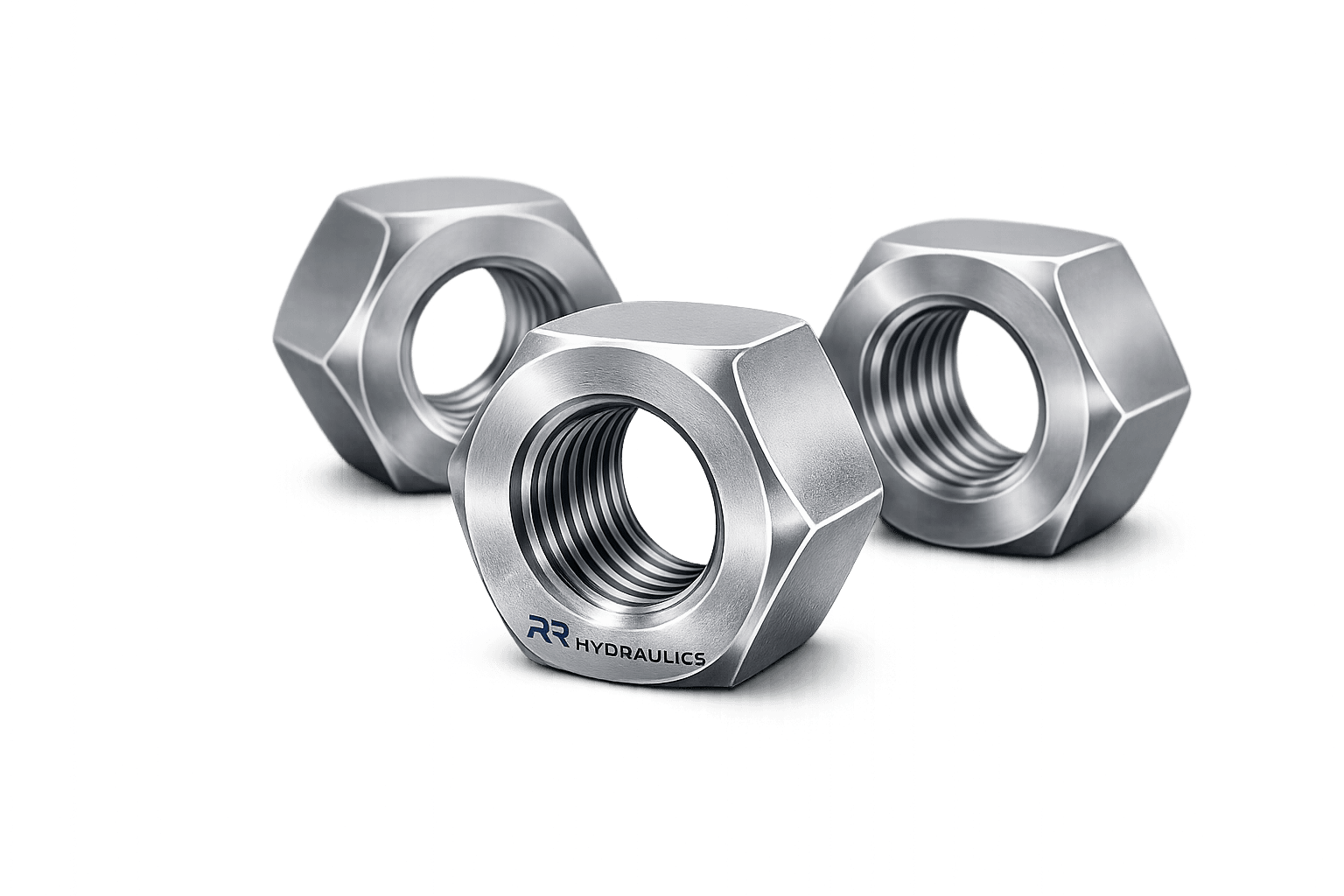
Hex Nut Types, Standards
& Design Principles
Definition and Engineering Function
A hex nut is a type 1 internally threaded fastener with a regular hexagonal external profile, designed to mate with a bolt, stud or threaded rod to clamp two or more components. The hexagonal form provides six wrench-engagement faces, enabling torque application via open-end, box-end, socket and powered wrenches. In structural, piping, pressure vessel, machinery and EPC project applications, the hex nut is the primary device for converting applied torque into controlled axial bolt preload — the clamping force that maintains joint integrity against separating forces, vibration and thermal cycling.
Hex nut selection involves five coupled engineering decisions: (1) thread form and size matching the bolt specification; (2) property class or grade sufficient to develop the required bolt proof load without stripping; (3) nut height — standard, thick or thin — appropriate to the engagement length requirement; (4) material grade for the service environment; and (5) surface protection for corrosion resistance during service life and storage. A mismatch in any of these leads to either strip failure, under-utilisation of bolt strength, or premature corrosion.
A hex nut must never be paired with a bolt of higher property class than the nut’s rated grade. Standard practice: ISO 8 nut with 8.8 bolt; ISO 10 nut with 10.9 bolt; A194 2H nut with A193 B7 stud. Mismatched pairing causes thread stripping in the nut body before the bolt reaches proof load — failure mode is silent and catastrophic.
Hex Nut Types — Complete Engineering Descriptions
Key Governing Standards
DIN 934 — the foundational European metric hex nut standard, defining dimensions, tolerances and material strength for nuts M1 to M52. Widely specified in DIN-based piping, machinery and structural applications globally. Superseded in part by ISO 4032 but both remain current in project specifications.
ISO 4032 — the international equivalent of DIN 934, part of the ISO metric hexagon product series. ISO 4032 defines style 1 (standard height) nuts from M1.6 to M64. Companion standards ISO 4033 (thick), ISO 4035 (thin), ISO 4161 (flange) and ISO 7042 (prevailing torque) cover the full type range.
ASME B18.2.2 — the primary US standard for inch-series hex nuts, covering square, hex, heavy hex, hex slotted, hex castle and heavy hex slotted types in UNC and UNF thread series from 1/4″ to 4″. Heavy hex nuts per B18.2.2 are mandatory for ASME code bolting with ASTM A193 studs.
ASTM A194 — the dominant material standard for carbon steel, alloy steel and stainless steel hex nuts used in high-pressure and high-temperature bolting. Grade 2H (carbon steel, Q&T) is the standard pairing for A193 B7 studs. Grade 7 (alloy steel) pairs with A320 L7 studs in low-temperature service.
| Type | Standard | Height | Property Class | Primary Application |
|---|---|---|---|---|
| Standard Hex | DIN 934 / ISO 4032 | ~0.8d | 5, 6, 8, 10, 12 | General structural, machinery, piping |
| Heavy Hex | ASME B18.2.2 / A194 | ~0.9d | 2H, 7, 2HM | ASME code pressure vessels & piping |
| Thin / Jam Nut | DIN 439 / ISO 4035 | ~0.5d | 04, 05 | Jam-locking, confined space, fine threads |
| Hex Flange Nut | DIN 6923 / ISO 4161 | ~0.8d | 6, 8, 10 | No separate washer required, automotive |
| Coupling Nut | DIN 6334 / ISO 4033 | ~3.0d | 6, 8 | Rod extension, anchor bolt assembly |
| Prevailing Torque | DIN 982/985 / ISO 7042 | ~0.9d | 8, 10 | Vibration-resistant joints, OEM assembly |
| Castle / Slotted | DIN 937/979 / B18.2.2 | ~1.0d | 5, 8 | Safety-critical, split-pin retention |
| Thick Hex | ISO 4033 / DIN 6915 | ~1.0d | 8, 10, HV | Preloaded structural bolting, EN 14399 |
| Weld Nut | DIN 929 / ISO 21670 | ~0.8d | 4, 6 | Sheet metal, blind access assemblies |
Dimensional Data, Property Classes
& Thread Specifications
Metric Hex Nut Dimensional Data — ISO 4032 / DIN 934
| Thread Size | Pitch (mm) | Width Across Flats s (mm) | Width Across Corners e (mm) | Nut Height m (mm) | Min. Bearing Dia. (mm) |
|---|---|---|---|---|---|
| M6 | 1.00 | 10.0 | 11.05 | 5.2 | 6.4 |
| M8 | 1.25 | 13.0 | 14.38 | 6.8 | 8.4 |
| M10 | 1.50 | 16.0 | 17.77 | 8.4 | 10.5 |
| M12 | 1.75 | 18.0 | 20.03 | 10.8 | 13.0 |
| M16 | 2.00 | 24.0 | 26.75 | 14.8 | 17.0 |
| M20 | 2.50 | 30.0 | 32.95 | 18.0 | 21.0 |
| M24 | 3.00 | 36.0 | 39.55 | 21.5 | 25.0 |
| M30 | 3.50 | 46.0 | 50.85 | 25.6 | 31.0 |
| M36 | 4.00 | 55.0 | 60.79 | 31.0 | 37.0 |
| M42 | 4.50 | 65.0 | 71.30 | 34.0 | 43.0 |
| M48 | 5.00 | 75.0 | 82.60 | 38.0 | 50.0 |
| M56 | 5.50 | 85.0 | 93.56 | 45.0 | 58.0 |
| M64 | 6.00 | 95.0 | 104.86 | 51.0 | 66.0 |
| M72 | 6.00 | 105.0 | 116.16 | 58.0 | 74.0 |
| M80 | 6.00 | 115.0 | 127.02 | 64.0 | 82.0 |
| M100 | 6.00 | 145.0 | 163.00 | 80.0 | 103.0 |
Dimensions per ISO 4032:2012 / DIN 934:2000 tolerance class A for M1.6–M16, class B for M18–M64. Verify current revision for procurement.
| Thread Size | TPI (UNC) | Width Across Flats (in) | Width Across Corners (in) | Nut Height (in) | ASTM Grade |
|---|---|---|---|---|---|
| 1/2″ | 13 | 7/8 | 1.010 | 31/64 | A194 2H / 2HM |
| 5/8″ | 11 | 1-1/16 | 1.227 | 39/64 | A194 2H / 2HM |
| 3/4″ | 10 | 1-1/4 | 1.443 | 47/64 | A194 2H / 2HM |
| 7/8″ | 9 | 1-7/16 | 1.660 | 55/64 | A194 2H / 7 |
| 1″ | 8 | 1-5/8 | 1.876 | 63/64 | A194 2H / 7 |
| 1-1/8″ | 7 | 1-13/16 | 2.093 | 1-7/64 | A194 2H / 7 |
| 1-1/4″ | 7 | 2″ | 2.309 | 1-7/32 | A194 2H / 7 |
| 1-1/2″ | 6 | 2-3/8″ | 2.742 | 1-27/64 | A194 2H / 7 |
| 1-3/4″ | 5 | 2-3/4″ | 3.175 | 1-39/64 | A194 2H |
| 2″ | 4.5 | 3-1/8″ | 3.608 | 1-3/4″ | A194 2H |
ASME B18.2.2-2010. Heavy hex dimensions are mandatory for ASME code bolted pressure joints with A193 B7/B8 studs.
Property Classes — ISO System (Metric)
ISO 898-2 defines property classes for metric hex nuts based on proof load stress (the minimum stress the nut thread must sustain without stripping). The class designation is a single number: class 5 for M1.6–M4 (structural general purpose); class 6 for M1.6–M39 general use; class 8 for mating with 8.8 bolts — the most common structural grade; class 10 for 10.9 bolt pairing; class 12 for 12.9 bolt pairing in high-strength applications. The number indicates the minimum proof load stress in multiples of 100 N/mm².
| ISO Class | Proof Load Stress (MPa) | Min. Hardness (HB) | Bolt Grade Pairing | Typical Material |
|---|---|---|---|---|
| ISO 5 | 500 | — | 4.6 / 4.8 | Carbon steel, as-drawn |
| ISO 6 | 600 | — | 5.6 / 5.8 / 6.8 | Carbon steel |
| ISO 8 | 800 | ≥200 | 8.8 (primary) | Carbon steel (Q&T) |
| ISO 10 | 1000 | ≥250 | 10.9 | Alloy steel (Q&T) |
| ISO 12 | 1200 | ≥295 | 12.9 | Alloy steel (Q&T), high-strength |
| ASTM A194 2H | 175 ksi proof | ≥235 HB (max 300) | A193 B7 stud | Carbon steel, Q&T per A194 |
| ASTM A194 7 | 175 ksi proof | ≥235 HB | A320 L7 (low-temp) | Alloy steel, Q&T (to −100°F) |
| ASTM A194 2HM | 175 ksi proof | ≤235 HB (NACE) | A193 B7M | CS Q&T, NACE MR0175 compliant |
| ASTM A194 8 (A2) | — | ≤321 HB | A193 B8 (304 SS) | Stainless 304 |
| ASTM A194 8M (A4) | — | ≤321 HB | A193 B8M (316 SS) | Stainless 316 |
| Thread | Grade | Dry Torque (N·m) | Lubricated Torque (N·m) | Proof Load Force (kN) | Notes |
|---|---|---|---|---|---|
| M8 | Cl. 8 | 26 | 20 | 18.4 | K=0.20 dry / K=0.15 lub. |
| M10 | Cl. 8 | 52 | 39 | 29.5 | |
| M12 | Cl. 8 | 91 | 68 | 43.2 | |
| M16 | Cl. 8 | 220 | 165 | 79.1 | |
| M20 | Cl. 8 | 430 | 322 | 124 | Verify wrench calibration |
| M24 | Cl. 8 | 750 | 562 | 177 | |
| M30 | Cl. 8 | 1500 | 1125 | 281 | Hydraulic torque tool |
| M36 | Cl. 8 | 2600 | 1950 | 404 | Hydraulic torque tool |
| 3/4″-10 | A194 2H | 235 | 176 | 134 | ASME code bolting, lubricated |
| 1″-8 | A194 2H | 566 | 425 | 235 | ASME code bolting, lubricated |
| 1-1/4″-7 | A194 2H | 1107 | 830 | 370 | |
| 1-1/2″-6 | A194 2H | 1922 | 1442 | 534 |
T = K × d × F. K=0.20 dry; K=0.15 lubricated (MoS₂ grease or heavy machine oil). Apply in a minimum of two stages. Values are reference — always confirm with project bolt calculation.
Material Grades, Mechanical Properties
& Surface Treatments
| Grade | Standard | UTS (MPa) | Proof Load (MPa) | Hardness | Temp Range (°C) | Corrosion | Application |
|---|---|---|---|---|---|---|---|
| A194 Gr. 2H | ASTM A194 | ≥1034 | 1207 (175 ksi) | 235–300 HB | −29 to +399 | Low | ASME code piping & pressure vessels with B7 studs |
| A194 Gr. 2HM | ASTM A194 | ≥1034 | 1207 | ≤235 HB (NACE) | −29 to +399 | Low | NACE MR0175 sour service — hardness controlled |
| A194 Gr. 7 | ASTM A194 | ≥1034 | 1207 | 235–300 HB | −101 to +399 | Low | Low-temperature service with A320 L7 studs |
| A563 Gr. DH | ASTM A563 | — | 1034 (150 ksi) | ≥300 HB | General | Low | Structural bolting with A325/A490 bolts |
| ISO Class 8 | ISO 898-2 | — | 800 | ≥200 HV | −50 to +300 | Low | Metric structural & machinery — with 8.8 bolts |
| A194 Gr. 8 (304) | ASTM A194 | ≥689 | — | ≤321 HB | −196 to +650 | High | General corrosion-resistant service with B8 studs |
| A194 Gr. 8M (316) | ASTM A194 | ≥689 | — | ≤321 HB | −196 to +650 | Very High | Chloride & chemical environments with B8M studs |
| Duplex 2205 | ASTM F594 / EN 20898 | ≥690 | — | ≤310 HB | −50 to +300 | Very High | Offshore, sour gas, chloride environments |
| Super Duplex | ASTM F594 | ≥795 | — | ≤310 HB | −50 to +300 | Extreme | Severe sour service, subsea, high-chloride |
| Inconel 625 | ASTM B564 | ≥827 | — | ≤241 HB | −200 to +980 | Extreme | High-temperature, highly corrosive process |
| Monel 400 | ASTM B164 | ≥482 | — | — | −200 to +480 | High — seawater | Marine, seawater, hydrofluoric acid service |
| Hastelloy C-276 | ASTM B574 | ≥690 | — | — | −73 to +1040 | Extreme | Chemical processing, FGD, pharma |
NACE MR0175 / ISO 15156 Requirements for Hex Nuts
In sour service (H₂S partial pressure above the threshold defined in NACE MR0175 Part 1), hex nuts in carbon steel must meet the hardness restriction of ≤22 HRC (237 HB) throughout the cross-section. The standard ASTM A194 Grade 2H nut has a hardness range of 235–300 HB — the upper range exceeds NACE requirements. Grade 2HM is the NACE-compliant equivalent with a maximum hardness restriction of 235 HB (22 HRC), specifically manufactured and marked 2HM to distinguish from standard 2H. Procurement specifications for sour service must explicitly call for Grade 2HM; Grade 2H is not acceptable without hardness verification.
| Finish / Coating | Standard | Thickness (µm) | Protection | Max Temp (°C) | Notes |
|---|---|---|---|---|---|
| Plain / Bare | — | — | None | — | Short-term storage only; apply VCI for export |
| Black oxide | MIL-DTL-13924 | 0.5–2 | Very Low | 150 | Cosmetic only; must be oiled post-process |
| Zinc electroplate | ASTM B633 SC1/SC3 | 5–25 | Moderate | 150 | Standard for commercial fasteners; ASTM B633 SC3 = 13 µm min |
| Hot-dip galvanise | ASTM A153 Class C/D | 45–86 | Excellent | 200 | Class C (≥45 µm) for nuts. Thread overcut required — DIN 267-10 |
| Zinc-nickel alloy | ASTM B841 | 8–15 | Very Good | 200 | 500–1000 hr salt spray. Preferred for offshore-adjacent environments |
| Mechanical zinc | ASTM B695 | 5–25 | Good | 150 | No hydrogen embrittlement risk vs. electroplating; suitable for high-strength nuts ≥ Cl.10 |
| PTFE / Xylan | Whitford spec. | 15–30 | Good + low friction | 230 | Low K-factor (0.08–0.12); improves torque consistency on large nuts |
| Electroless nickel | ASTM B733 SC4 | 25–50 | Very Good | 400 | Uniform thickness on complex internal threads; excellent for SS-to-CS galling prevention |
| Phosphate + oil | MIL-DTL-16232 | 5–15 | Low–Moderate | 100 | Pre-treatment base for paint; consistent K-factor for bolting calculations |
| Dacromet / Geomet | ISO 10683 | 8–12 | Very Good | 300 | No H₂ embrittlement; excellent for high-strength nuts. 720+ hr salt spray |
Hot-dip galvanised nuts require thread overcut per DIN 267-10 to accommodate zinc build-up. Verify K-factor when calculating torque for HDG assemblies (K typically 0.18–0.22 for HDG vs. 0.12–0.16 for PTFE-coated).
Electroplating of high-strength nuts (ISO Class 10/12, A194 2H with HB ≥ 320) introduces atomic hydrogen that can cause delayed fracture — hydrogen embrittlement (HE). ASTM F1941 requires baking at 190–220°C for minimum 8 hours post-plating for fasteners above 39 HRC. For critical applications above Class 10, mechanical zinc (ASTM B695), Dacromet/Geomet or hot-dip galvanising are preferred alternatives that carry no HE risk.
Inspection, QC Protocols, Applications
& Export Documentation
Inspection and QC Requirements
Width across flats, width across corners, nut height and chamfer dimensions are verified per ISO 4032 or ASME B18.2.2 tolerances using calibrated gauges. Thread gauging (Go/No-Go per ISO 1502 or ASME B1.2) is performed at incoming inspection on every batch received. For project supply, 100% visual inspection plus AQL sampling per ISO 2859 (typically AQL 1.0 or 0.65 for critical fasteners) is applied at the point of packing.
Proof load testing per ISO 898-2 (or ASTM A194 Section 6) is the primary mechanical qualification test for hex nuts — the nut is loaded axially to proof load force and must not crack, fracture, or strip. Hardness testing (Brinell HB per ISO 6506 or Rockwell HRC per ISO 6508) is performed on minimum one nut per lot; for NACE MR0175 compliance on Grade 2HM, hardness is verified on every heat. Charpy impact testing at −46°C is required for A194 Grade 7 nuts in low-temperature service.
Type 3.1: Validated by the manufacturer’s own authorised inspector. Minimum requirement for standard EPC and OEM project supply. Must state standard, grade, heat/lot number, chemical analysis, mechanical test results and heat treatment condition. Type 3.2: Co-validated by independent TPI body (BV, DNV, Lloyds, SGS, TÜV) nominated by the purchaser. Mandatory for offshore, NACE service, nuclear-adjacent and Class 1 pressure boundary applications.
For stainless steel, duplex, and alloy grades, Positive Material Identification (PMI) by XRF or OES spectrometry is mandatory to confirm alloy composition matches the MTC. PMI is particularly critical when multiple grades are in inventory simultaneously — grade mix-ups in hex nut stocks are a known failure mode in project supply chains.
Applications by Industry
ASME B31.3 Process Piping and ASME VIII Pressure Vessel code require heavy hex nuts per ASTM A194 Grade 2H (or 2HM for sour service) paired with ASTM A193 B7 stud bolts on flanged connections Class 150 through Class 2500. All nuts must be traceable to a certified heat with a 3.1 MTC minimum; 3.2 MTC with TPI witness is required on offshore installations and safety-critical in-line equipment. NACE MR0175 hardness compliance must be verified for all subsea and sour service applications.
Structural hex nuts in building, bridge and industrial structure applications follow ISO 898-2 (metric) or ASTM A563/F436 (inch). For preloaded structural bolt assemblies under EN 14399 (the European standard for high-strength structural bolting), the nut, bolt and washer are supplied and tested as a matched assembly — individual component substitution is not permitted. Galvanised hex nuts per ASTM A153 Class C are standard for atmospheric exposure applications.
Steam turbine and pressure vessel flanged joints use A194 2H heavy hex nuts with A193 B7 studs for carbon steel systems. For austenitic high-temperature applications (above 400°C), A194 Grade 8 (304 SS) or Grade 8M (316 SS) nuts are specified per ASME Code Case or material exemption. Molybdenum disulfide or never-seize compound is applied to all nut-to-stud threads and nut bearing faces to ensure accurate torque-to-preload conversion and facilitate future disassembly.
Topside structural connections on offshore platforms use zinc-nickel or Dacromet-coated hex nuts to resist chloride-accelerated corrosion. For subsea connections, duplex 2205 or super duplex nuts are standard, with PREN (pitting resistance equivalent number) verification required per batch chemistry. ISO 9001:2015-certified supply with EN 10204 3.2 MTC is a mandatory contract requirement on all major offshore EPC packages.
Export Packaging and Preservation
- Nuts packed in heavy-duty polypropylene bags sealed with twist-tie or heat seal, batch labelled with PO, grade, size, standard and heat number
- Bags placed in double-wall corrugated cardboard cartons with foam or newspaper void fill to prevent movement and corrosion by abrasion
- VCI (Volatile Corrosion Inhibitor) paper or poly liner inside each carton for plain/bare finish nuts
- Cartons packed in ISPM-15 heat-treated timber pallet crates for sea freight export
- MTC, test reports and packing list in waterproof sealed envelope, copy attached to outer crate, original with shipping documents
- Pallet stretch-wrapped with 50% overlap, minimum two strapping bands per pallet
- Gross weight, net weight, dimensions and handling instructions marked on all outer packages
| # | Document | Standard | Requirement |
|---|---|---|---|
| 01 | Material Test Certificate (MTC) | EN 10204 3.1 / 3.2 | 3.2 for offshore / NACE / nuclear applications |
| 02 | Proof Load Test Report | ISO 898-2 / ASTM A194 §6 | Per heat/lot — mandatory for A194 2H, 7, 8M |
| 03 | Hardness Test Report | ISO 6506 / ISO 6508 | 100% heat verification for NACE 2HM |
| 04 | Dimensional Inspection Report | ISO 4032 / ASME B18.2.2 | AQL 1.0 per ISO 2859 on each dispatch batch |
| 05 | Thread Gauge Certificate | ISO 1502 / ASME B1.2 | Go/No-Go per heat for project supply |
| 06 | PMI Report (XRF / OES) | Project spec / XRF cert | 100% of SS, duplex, alloy and exotic grades |
| 07 | Chemical Analysis Report | ASTM A194 / ISO 898 | Included in MTC — verify against grade limits |
| 08 | Heat Treatment Certificate | ASTM A194 §5 | Required for Q&T grades (2H, 7, 2HM) |
| 09 | Charpy Impact Report | ASTM A370 / ISO 148 | Mandatory for A194 Gr. 7 (low-temperature service) |
| 10 | ISO 9001 Manufacturer Certificate | ISO 9001:2015 | Current; scope must include fastener manufacture |
| 11 | Packing List / Traceability Record | Project MRB format | Heat-number-level traceability to PO line item |
| 12 | ISPM-15 Phytosanitary Certificate | IPPC / FAO | All wood packing for international export |
RR Hydraulics manufactures and exports hex nuts in all grades — carbon steel, stainless steel, alloy steel, duplex & super duplex, Inconel, Monel and Hastelloy — to DIN 934, ISO 4032, ASME B18.2.2, ASTM A194 and all major standards. Full EN 10204 3.1/3.2 documentation, ISO 9001:2015 QMS, TPI witness by BV/DNV/Lloyds/SGS/TÜV. M3–M100 metric and 1/4″–4″ inch range. 48-hour express dispatch on in-stock sizes. NACE MR0175-compliant Grade 2HM available with full hardness certification.