
Submit an R.F.Q. — Coupling Nuts
Technical sales team responds within 24 hours. EPC & project pricing across all coupling nut types, grades and sizes.
R.F.Q. Submitted Successfully
Our technical team will contact you within 24 hours.
Reference: sales@rrhydraulics.com
Coupling Nuts
A comprehensive engineering reference for EPC contractors, structural engineers, procurement heads and TPI agencies — covering coupling nut types, threaded rod joining mechanics, extension and reducing configurations, dimensional standards, property classes, material grades, surface treatments and full project documentation requirements.
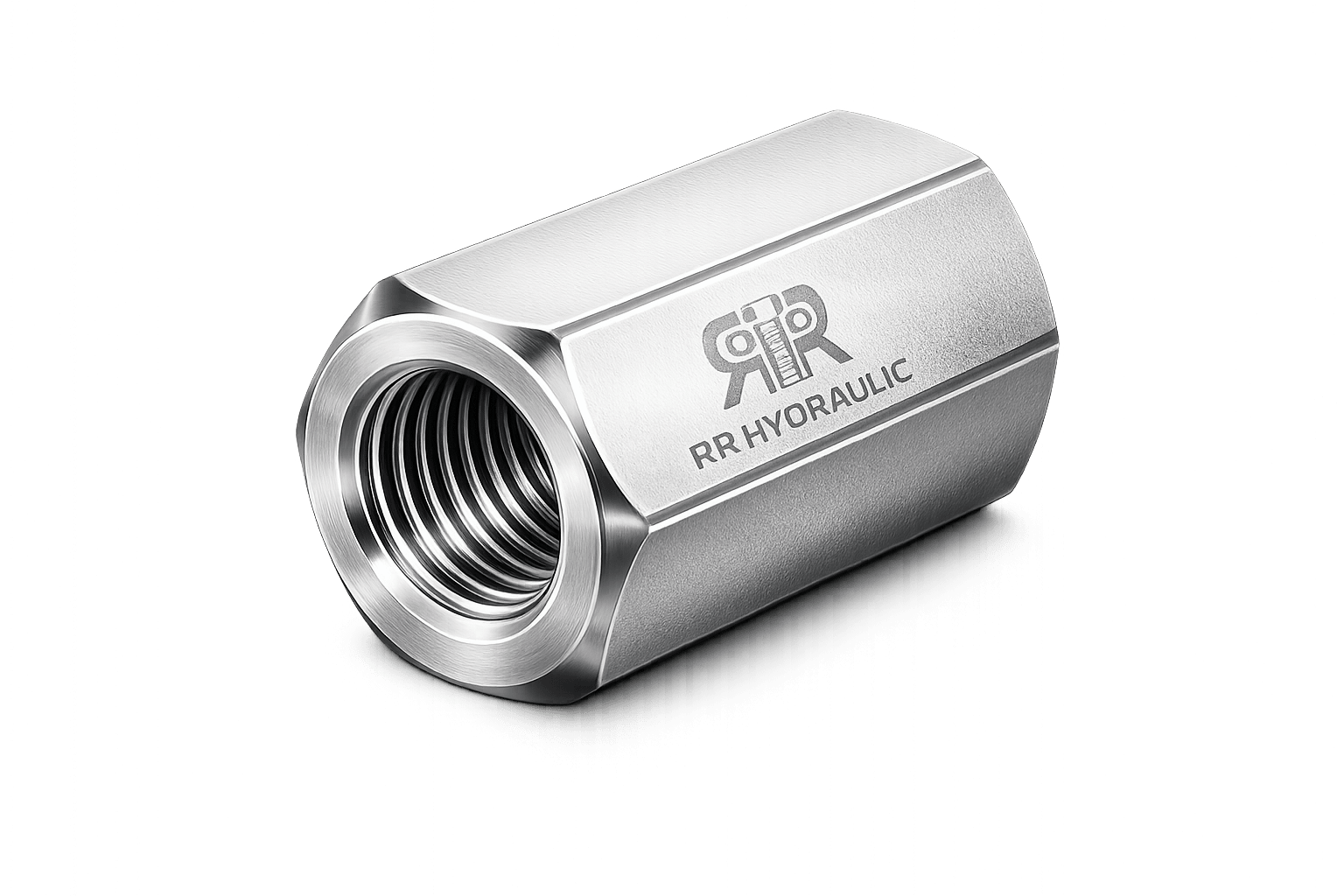
Coupling Nut Types, Engineering Function
& Rod Extension Mechanics
Hex · Round · Reducing · Anchor · Turnbuckle · Tie-Rod
Definition and Engineering Function
A coupling nut (also called a hex coupling nut, extension nut, long nut, rod coupling nut or stud joiner) is an internally threaded fastener of substantially greater length than a standard hex nut — typically 3–4× the nominal thread diameter — designed to join two externally threaded components (bolts, studs, threaded rods) end-to-end along their common longitudinal axis. Both ends of the coupling nut engage the mating threads simultaneously, transmitting the full tensile or compressive axial load between the two joined components through the internal thread engagement at each end.
Coupling nuts are the engineering solution in four principal scenarios: (1) rod extension — extending a threaded rod, anchor bolt or stud beyond its manufactured length without cutting or splicing the parent material; (2) height adjustment — providing a threadedly adjustable spacer of variable axial length between two components (e.g., machinery levelling feet, suspension adjustment, formwork tie adjustment); (3) grade transition — joining a high-strength bolt to a standard threaded rod when the design load requires the high-strength material at one end only; and (4) mixed-thread coupling — the reducing coupling nut variant joins two components of different thread sizes or pitches at either end.
The total internal thread length of a coupling nut is its primary engineering parameter. Each end of the coupling nut must provide a minimum thread engagement length of 1.0× nominal diameter for ISO grade 6H/6g fits in carbon steel (per ISO 898), or 1.5× nominal diameter for thread engagements in aluminium, cast iron or other materials with lower thread strength than the bolt grade. The extended body of the coupling nut (typically 3–4×d) ensures sufficient engagement depth on both ends simultaneously, while the central body provides the wrench-grip section. A coupling nut must never be used as a structural tension member between two rods at a load exceeding the thread engagement proof load of the nut body material.
Coupling Nut Types — Complete Engineering Descriptions
Rod Extension and Coupling Installation — Procedure
The single most common coupling nut failure in the field is insufficient thread engagement at one or both ends. If a rod bottoms out inside the coupling nut and the coupling nut is tightened further, the rod end contacts the opposite rod inside the bore — the coupling nut body appears tight but neither rod is in tension. This is a hidden failure mode that produces a joint with zero load capacity. Always mark engagement depth with paint or permanent marker before and after final torque, and confirm both marks are at the correct position at ≥1.0×d from the coupling nut face. For safety-critical applications, specify coupling nuts with a central inspection window or groove to allow visual verification that both rods are engaged to the midpoint.
| Type | Standard | Thread Config | Wrench Type | Body Length | Primary Application |
|---|---|---|---|---|---|
| Std Hex Coupling Nut | DIN 6334 / ISO 8992 | Same both ends | Open-end / ring | 3×d | Rod joining, anchor extension, adjustment |
| Heavy Hex Coupling Nut | ASME B18.2.2 / A194 | Same both ends | Open-end / ring | 3×d | ASME piping, structural B7 stud extension |
| Round Coupling Nut | DIN 6334 round / custom | Same both ends | Hook / pin spanner | 3×d | Architectural rods, bore-limited access |
| Reducing Coupling Nut | Custom / project spec | Different each end | Open-end / ring | 3–4×d (larger) | Grade / size transition, mixed thread joining |
| Anchor Bolt Coupling Nut | ASME B18.2.2 / structural | Same both ends | Hydraulic torque | 4×d | Foundation anchor bolt extension above slab |
| Turnbuckle / Tie-Rod Body | DIN 1480 / custom | RH + LH thread | Spanner wrench | 4–6×d | Adjustable tension rods, facade cables, bracing |
Dimensional Data, Governing Standards
& Thread Engagement Reference
Width Across Flats · Body Length · Thread Engagement · Proof Load
DIN 6334 Hex Coupling Nut — Dimensional Data
| Thread | Pitch (mm) | W/F s (mm) | W/C e (mm) | Body Length L (mm) | Min Thread Eng. Each End (mm) | Proof Load Stress (MPa) | Property Class |
|---|---|---|---|---|---|---|---|
| M6 | 1.00 | 10.0 | 11.55 | 18.0 | 6.0 | 800 | 8 |
| M8 | 1.25 | 13.0 | 15.01 | 24.0 | 8.0 | 800 | 8 |
| M10 | 1.50 | 17.0 | 19.60 | 30.0 | 10.0 | 800 | 8 |
| M12 | 1.75 | 19.0 | 21.90 | 36.0 | 12.0 | 800 | 8 |
| M16 | 2.00 | 24.0 | 27.71 | 48.0 | 16.0 | 800 | 8 |
| M20 | 2.50 | 30.0 | 34.64 | 60.0 | 20.0 | 800 | 8 |
| M24 | 3.00 | 36.0 | 41.57 | 72.0 | 24.0 | 800 | 8 |
| M30 | 3.50 | 46.0 | 53.12 | 90.0 | 30.0 | 800 | 8 |
| M36 | 4.00 | 55.0 | 63.51 | 108 | 36.0 | 800 | 8 |
| M42 | 4.50 | 65.0 | 75.06 | 126 | 42.0 | 800 | 8 |
| M48 | 5.00 | 75.0 | 86.60 | 144 | 48.0 | 800 | 8 |
| M52 | 5.00 | 80.0 | 92.38 | 156 | 52.0 | 800 | 8 |
DIN 6334:2000 / ISO 8992. Body length = 3× nominal thread diameter (standard). Thread tolerance class 6H throughout. Proof load per ISO 898-2. Property class 8 standard; class 10 on request for M6–M30. Min thread engagement each end = 1.0×d for steel-to-steel coupling; increase to 1.5×d for aluminium mating threads.
| Thread Size | TPI (UNC) | W/F (in) | Body Length (in) | Min Thread Eng. (in) | ASTM Grade |
|---|---|---|---|---|---|
| 1/4" | 20 | 7/16 | 13/16 | 1/4 | A563 / A194 2H |
| 3/8" | 16 | 9/16 | 1-3/16 | 3/8 | A563 / A194 2H |
| 1/2" | 13 | 3/4 | 1-9/16 | 1/2 | A563 / A194 2H |
| 5/8" | 11 | 15/16 | 1-15/16 | 5/8 | A563 / A194 2H |
| 3/4" | 10 | 1-1/8 | 2-5/16 | 3/4 | A563 / A194 2H |
| 7/8" | 9 | 1-5/16 | 2-11/16 | 7/8 | A563 / A194 2H |
| 1" | 8 | 1-1/2 | 3-1/16 | 1 | A563 / A194 2H |
| 1-1/4" | 7 | 1-7/8 | 3-13/16 | 1-1/4 | A563 / A194 2H |
| 1-1/2" | 6 | 2-1/4 | 4-9/16 | 1-1/2 | A563 / A194 2H |
| 2" | 4.5 | 3 | 6-1/16 | 2 | A563 / A194 2H |
ASME B18.2.2-2010. Thread tolerance class 2B per ASME B1.1. A194 Grade 2H for structural/piping; Grade 2HM for NACE MR0175 sour service. Body length = 3.0× nominal diameter standard.
Governing Standards and Engineering Specifications
DIN 6334 is the primary European standard for hex coupling nuts, covering metric sizes M5 to M52 in property classes 8 and 10. It defines width across flats, body length (3×d standard), thread tolerance class 6H and marking requirements. ISO 8992 is the international equivalent, aligned dimensionally with DIN 6334. ASME B18.2.2 covers inch-series hex and heavy hex coupling nuts from 1/4" to 2" UNC. For ASME code pressure equipment, ASTM A194 Grade 2H heavy hex coupling nuts are the standard for structural B7 stud extension, and Grade 2HM for sour service zones per NACE MR0175. Non-standard coupling nut lengths (4×d, 5×d, 6×d) are available to project-specific drawings — these require a dedicated dimensional inspection report and MTC referencing the customer drawing number.
| ISO Class | Proof Load (MPa) | Min. Hardness (HV) | Max. Hardness (HV) | Bolt/Stud Pairing | Material |
|---|---|---|---|---|---|
| ISO 8 | 800 | 200 | 302 | 8.8 bolt / B7 stud | Carbon steel Q&T |
| ISO 10 | 1040 | 272 | 353 | 10.9 bolt | Carbon steel Q&T |
| A194 2H | 1207 (175 ksi) | 235–300 HB | — | A193 B7 / B16 stud | Carbon steel Q&T |
| A194 2HM | 1207 (175 ksi) | ≤235 HB (NACE) | — | A193 B7M stud (NACE) | Carbon steel Q&T |
| A2-70 | 700 | — | 320 HV | A2-70 stud | SS 304 |
| A4-70 | 700 | — | 320 HV | A4-70 stud | SS 316L |
| A4-80 | 800 | — | 320 HV | A4-80 stud | SS 316L cold-worked |
F_strip ≈ 0.577 × σ_y_nut × π × d × L_eng × η // Approximate thread strip load [N]; η = thread efficiency factor (~0.5–0.6)
F_strip ≥ F_bolt_proof // Engagement length must ensure strip load exceeds bolt proof load
// WORKED EXAMPLE: M16 DIN 6334 Class 8 coupling nut (σ_y = 640 MPa), bolt proof load = 64 kN
L_eng_min = 1.0 × 16 = 16 mm // Standard DIN 6334 M16 body = 48 mm; each end engagement = 24 mm ≥ 16 mm → adequate
F_strip ≈ 0.577 × 640 × π × 16 × 16 × 0.55 = ~162 kN // Well exceeds bolt proof load of 64 kN → thread strip is not limiting
Material Grades, Mechanical Properties
& Surface Treatments
NACE · HDG · Zinc · Dacromet · Passivation
| Grade | Standard | Proof Load (MPa) | Hardness | Temp (°C) | Corrosion | Key Application |
|---|---|---|---|---|---|---|
| CS Class 8 | ISO 898-2 / DIN 6334 | 800 | 200–302 HV | −50 to +300 | Low | General rod coupling, anchor extension, structural |
| CS Class 10 | ISO 898-2 | 1040 | ≥272 HV | −50 to +250 | Low | High-strength rod coupling, 10.9 bolt pairing |
| A194 Grade 2H | ASTM A194 | 1207 (175 ksi) | 235–300 HB | −29 to +399 | Low | ASME code B7 stud extension, pressure vessels |
| A194 Grade 2HM | ASTM A194 | 1207 (175 ksi) | ≤235 HB (NACE) | −29 to +399 | Low | NACE MR0175 sour service B7M stud extension |
| SS 304 (A2-70) | ISO 3506-2 | 700 | ≤320 HV | −196 to +650 | High | Outdoor, marine-adjacent, food, architectural rods |
| SS 316L (A4-70) | ISO 3506-2 | 700 | ≤320 HV | −196 to +650 | Very High | Offshore, chloride, chemical plant, tension rods |
| Duplex 2205 | ASTM A182 F51 | — | ≤310 HB | −50 to +300 | Very High | Offshore structural tie-rods, sour service anchors |
| Super Duplex | ASTM A182 F53 | — | ≤310 HB | −50 to +280 | Extreme | High-chloride subsea, severe sour service |
| Brass (CuZn37) | BS 2872 / ASTM B16 | — | ~120 HV | −50 to +180 | Good | Plumbing rod couplings, marine, decorative |
| Inconel 625 | ASTM B564 | — | ≤241 HB | −200 to +980 | Extreme | High-temp, chemical process, turbine stud extension |
| Monel 400 | ASTM B164 | — | — | −200 to +480 | High seawater | Marine, seawater, HF acid stud coupling |
| Hastelloy C-276 | ASTM B574 | — | ≤241 HB | −196 to +1038 | Extreme | Chemical process, FGD, aggressive acid/chloride |
NACE MR0175 Sour Service — Coupling Nuts
Coupling nuts in H≶S service zones must comply with NACE MR0175 / ISO 15156 maximum hardness of 22 HRC (237 HB) throughout the full cross-section. For carbon steel coupling nuts, this restricts the use of ISO Class 10 (minimum hardness 272 HV — exceeds NACE limit) and limits the quenching and tempering parameters for Grade 2H. Grade 2HM is the NACE-compliant equivalent of A194 2H, with a maximum hardness of 235 HB verified through the full body cross-section at multiple points — not just surface readings. Full cross-section hardness mapping (minimum 9-point grid including the centre) is mandatory for Grade 2HM certification. For duplex and super duplex coupling nuts, solution annealing and PREN verification per batch chemistry are required. The extended body of the coupling nut means the centre cross-section hardness is the most critical measurement point — it is furthest from the quenched surface and may differ from the outer face readings.
| Finish | Standard | Thickness (µm) | Salt Spray (hrs) | Max Temp (°C) | Notes & Application |
|---|---|---|---|---|---|
| Plain / Bare | — | — | <24 | — | Indoor dry storage; VCI for export |
| Black oxide + oil | MIL-DTL-13924 | 0.5–2 | 24–48 | 150 | Indoor; consistent K-factor for torque calculation |
| Zinc electroplate SC3 | ASTM B633 SC3 | 13 min | 200 | 150 | Standard outdoor industrial carbon steel coupling nuts |
| Hot-dip galvanise | ASTM A153 Class C | 45–86 | 500+ | 200 | Outdoor structural, anchor bolt extension; re-tap internal threads post-HDG |
| Mechanical zinc | ASTM B695 Cl.12 | 12 min | 200 | 150 | High-strength Class 10; no H₂ embrittlement risk |
| Dacromet / Geomet | ISO 10683 | 8–12 | 720+ | 300 | High-strength, high-temp; preferred for A194 2H/2HM |
| Zinc-nickel alloy | ASTM B841 | 8–15 | 500–1000 | 200 | Offshore-adjacent, marine coastal anchor extensions |
| SS 316L passivation | ASTM A380 | N/A | 1000+ | 870 | Offshore, food, pharma, chemical plant SS coupling nuts |
| PTFE / Xylan | Whitford spec. | 15–30 | 400+ | 230 | Anti-galling SS-to-SS; reduced K-factor for torque |
Hot-dip galvanised coupling nuts: the internal thread bore through the full body length must be re-tapped after galvanising per DIN 267-10. The long internal bore of a coupling nut traps significantly more zinc deposit than a standard nut, and inadequate re-tapping produces a coupling nut that cannot be assembled to the mating rods. Always specify "HDG + full-length thread bore re-tapped per DIN 267-10" on purchase orders for galvanised coupling nuts.
Stainless steel coupling nuts assembled onto stainless steel rods or studs (same alloy, e.g., SS 316L-to-SS 316L) are highly susceptible to galling — the cold-welding and tearing of the thread surfaces that occurs during thread engagement, particularly at high rotation speeds or without adequate lubrication. The extended thread engagement of a coupling nut (multiple full thread revolutions) substantially increases galling risk compared to a standard hex nut. For SS coupling nuts on SS rods: always apply a molybdenum disulphide (MoS₂) paste or anti-galling compound to both the rod threads and the coupling nut bore before assembly; never assemble dry; consider specifying the coupling nut in a different alloy (e.g., SS 316L nut on SS 304 rod) to exploit the slight hardness difference that reduces galling tendency.
Inspection, QC Protocols, Applications
& Export Documentation
Anchor Bolts · Structural · Offshore · Piping · Tension Rods
Inspection and Quality Control
Coupling nuts require full-length thread gauging — the Go gauge must traverse the entire internal thread bore from one end to the other without interference or binding. This is distinct from standard hex nut gauging where the Go gauge passes only 2–3 thread pitches. A coupling nut with a local thread defect, bore contamination, zinc deposit (in HDG units) or bore distortion at the midpoint will accept the Go gauge at both ends but fail to assemble to both rods simultaneously. Full-length Go gauge traversal is mandatory for each batch and is the single most important QC step unique to coupling nuts. The No-Go gauge must not engage more than two turns at either end. Body length is also measured as a mandatory dimension — a coupling nut that is too short reduces the engagement depth on one or both ends.
For structural, ASME code and NACE service coupling nuts, hardness is tested at the centre cross-section of the body — not at the ends. The centre is the point furthest from the surface in a solid cylinder and the least affected by quench cooling, making it the representative worst-case hardness location. For NACE Grade 2HM coupling nuts, a minimum of 9-point Vickers or Brinell hardness readings on the centre cross-section are required. Surface spot readings at the end faces are insufficient to confirm NACE compliance through the full body length.
Proof load testing of coupling nuts per ISO 898-2 applies the proof load stress axially to the full cross-section of the body through engagement of the thread at both ends simultaneously — this is the loading condition seen in service and is more demanding than the standard hex nut proof load test. For DIN 6334 Class 8, the proof load stress is 800 MPa applied to the stress area of the thread. The coupling nut must sustain the full proof load without stripping at either thread end and without permanent deformation of the body. Per batch testing at AQL 1.0 per ISO 2859 is required for project supply.
Type 3.1: Minimum for all EPC, OEM and structural project supply. Must state material standard, grade, heat/lot number, chemical analysis and mechanical test results (proof load at both ends, hardness at body centre section). Body length must be stated as a mandatory measured characteristic. Type 3.2: Co-validated by purchaser-nominated TPI body. Mandatory for offshore, NACE, pressure vessel and structural safety-critical applications. For Grade 2HM coupling nuts, the full cross-section hardness map (9-point minimum at centre cross-section) must be appended to the 3.2 certificate as a measured characteristic report.
Applications by Industry
Coupling nuts are essential components in civil and structural engineering where cast-in anchor bolt assemblies must be extended above the concrete slab level to accommodate base plate connections, equipment mounting frames, column base plates and machinery holddown systems. The coupling nut is pre-assembled onto the lower anchor bolt before concrete pour, and the upper extending rod is engaged after stripping the formwork. ASTM A194 Grade 2H heavy hex coupling nuts are standard for ASME code structural applications; hot-dip galvanised DIN 6334 Grade 8 coupling nuts are standard for general civil engineering anchor bolt extension.
Coupling nuts or turnbuckle coupling nuts are the standard splice element in adjustable tension rod systems used in glass facade bracing, cable-stayed roof structures, stadium roof ties, pedestrian bridge tension hangers and wind bracing systems. The coupling nut allows both length adjustment during erection and post-tensioning after structure completion. For architectural exposed tension rod systems where the coupling nut is visible, round coupling nuts in polished SS 316L or brass with decorative machined grooves are specified. For structural strength applications, DIN 6334 Class 10 or ASME A194 2H heavy hex coupling nuts are used.
ASTM A194 Grade 2H or 2HM heavy hex coupling nuts extend ASTM A193 B7 or B7M stud bolts in bolted flanged piping connections and pressure vessel cover assemblies where the stud bolt as-manufactured length is insufficient for the installed gasket thickness, insulation jacket or special flange dimensions. Offshore and process plant EPC projects require EN 10204 3.2 MTC, PMI, full body centre cross-section hardness survey and TPI countersignature for all coupling nuts in ASME code-rated connections.
Coupling nuts threaded onto levelling studs welded to machinery base frames provide infinitely variable height adjustment between the machine and its foundation. The coupling nut rotation produces axial displacement equal to the thread pitch per revolution, enabling sub-millimetre levelling precision. Lock nuts on the stud above and below the coupling nut lock the height setting after adjustment. Stainless steel 316L coupling nuts on stainless studs are specified in food-grade, pharmaceutical and chemical plant installations for cleanability and corrosion resistance.
In concrete formwork systems, hot-dip galvanised DIN 6334 coupling nuts on form tie rods connect and extend the through-rods that hold opposing formwork panels at the correct spacing during a concrete pour. The coupling nut allows the tie rod to be assembled from standard stock lengths and extended to the required pour width. After stripping, the tie rods are re-threaded back through the concrete and the coupling nuts removed for reuse. DIN 267-10 HDG thread overcut is critical here — standard-thread mating rods will not engage HDG coupling nuts without overcut internal threads.
Coupling nuts in offshore and O&G applications are found in structural framing rod extensions, conductor pipe clamp rod couplings, equipment skid base plate anchor bolt extensions and piping support stud extensions. In sour service zones, NACE A194 2HM heavy hex coupling nuts with EN 10204 3.2 MTC, full centre cross-section hardness survey, PMI and TPI witness are project-standard requirements. Duplex 2205 and super duplex coupling nuts are specified for subsea structural rod couplings and tie-back anchor systems where both corrosion resistance and NACE compliance are required.
Export Packaging and Preservation
- Coupling nuts packed in heat-sealed polypropylene bags, batch-labelled with PO number, type (DIN 6334 / ASME B18.2.2), grade, thread size, body length, heat/lot number and quantity
- VCI (Volatile Corrosion Inhibitor) poly liner in each bag for plain and black-oxide carbon steel coupling nuts for sea freight or long-term site storage
- Thread bores of large coupling nuts (M24 and above) individually capped with polyethylene plugs to prevent bore contamination, moisture ingress and oxidation during transit and storage
- Bags packed in double-wall corrugated cartons with foam or kraft paper void fill; long coupling nuts (M36–M52) may require individual tube packaging to prevent body damage from inter-nut contact
- Cartons secured on ISPM-15 heat-treated timber pallets with stretch wrap and minimum two steel strapping bands per pallet layer
- MTC, full-length thread gauge certificate, body length inspection report, proof load test report and all project documents in waterproof sealed envelope attached to crate exterior
- Outer crate labels: PO number, item tag, material grade, type, thread size, body length, standard, heat number, quantity, gross weight, country of origin
| # | Document | Standard / Reference | Minimum Requirement |
|---|---|---|---|
| 01 | Material Test Certificate (MTC) | EN 10204 3.1 / 3.2 | 3.2 for offshore / NACE / pressure vessel applications |
| 02 | Full-Length Thread Gauge Certificate | ISO 1502 / ASME B1.2 | Go gauge full traversal both ends — MANDATORY for all coupling nuts |
| 03 | Body Length Inspection Report | DIN 6334 / project spec | AQL 1.0 per ISO 2859; body length as mandatory measured characteristic |
| 04 | Proof Load Test Report | ISO 898-2 / ASTM A194 | Per heat/lot — axial load applied through thread engagement at both ends |
| 05 | Hardness Test Report (Centre Section) | ISO 6507 / ISO 6506 | Centre body cross-section — mandatory; 9-point grid for NACE 2HM |
| 06 | PMI Report (XRF / OES) | Project specification | 100% of SS, duplex, Inconel, Monel, Hastelloy and A194 2HM grade |
| 07 | Chemical Analysis Report | ISO 898 / ASTM A194 | Included in MTC; CE value for weldability if anchor bolt coupling |
| 08 | Heat Treatment Certificate | ISO 898-2 / ASTM A194 | Required for Q&T grades (Class 10, A194 2H, 2HM) |
| 09 | Surface Coating Certificate | ASTM A153 / B633 / ISO 10683 | Full-length bore re-tap confirmation mandatory for HDG coupling nuts |
| 10 | ISO 9001 Manufacturer Certificate | ISO 9001:2015 | Current; scope must include coupling nut manufacture |
| 11 | Packing List / Traceability Record | Project MRB format | Heat-number-level traceability; body length per unit stated |
| 12 | ISPM-15 Phytosanitary Certificate | IPPC / FAO | All wood packing for international export |
RR Hydraulics manufactures and exports coupling nuts in all types — DIN 6334 hex, heavy hex (ASME B18.2.2), round, reducing and custom length — in carbon steel, stainless steel 304/316L, duplex & super duplex, brass, Inconel 625, Monel 400 and Hastelloy C-276. Full EN 10204 3.1/3.2 MTC documentation, full-length thread gauge certificates, ISO 9001:2015 QMS and TPI witness by BV/DNV/Lloyds/SGS/TÜV accommodated. M6–M52 metric and 1/4"–2" inch. NACE MR0175-compliant A194 2HM with centre cross-section hardness mapping. Non-standard body lengths and reducing thread configurations to customer drawing. 48-hour express dispatch on in-stock sizes.