
Submit an R.F.Q. — Square Nuts
Technical sales team responds within 24 hours. EPC & project pricing across all grades and standards.
R.F.Q. Submitted Successfully
Our technical team will contact you within 24 hours.
Reference: sales@rrhydraulics.com
Square Nuts
A comprehensive engineering reference for EPC contractors, structural engineers, procurement heads and TPI agencies — covering square nut types, dimensional standards, property classes, material grades, surface treatments, torque data and full project documentation.
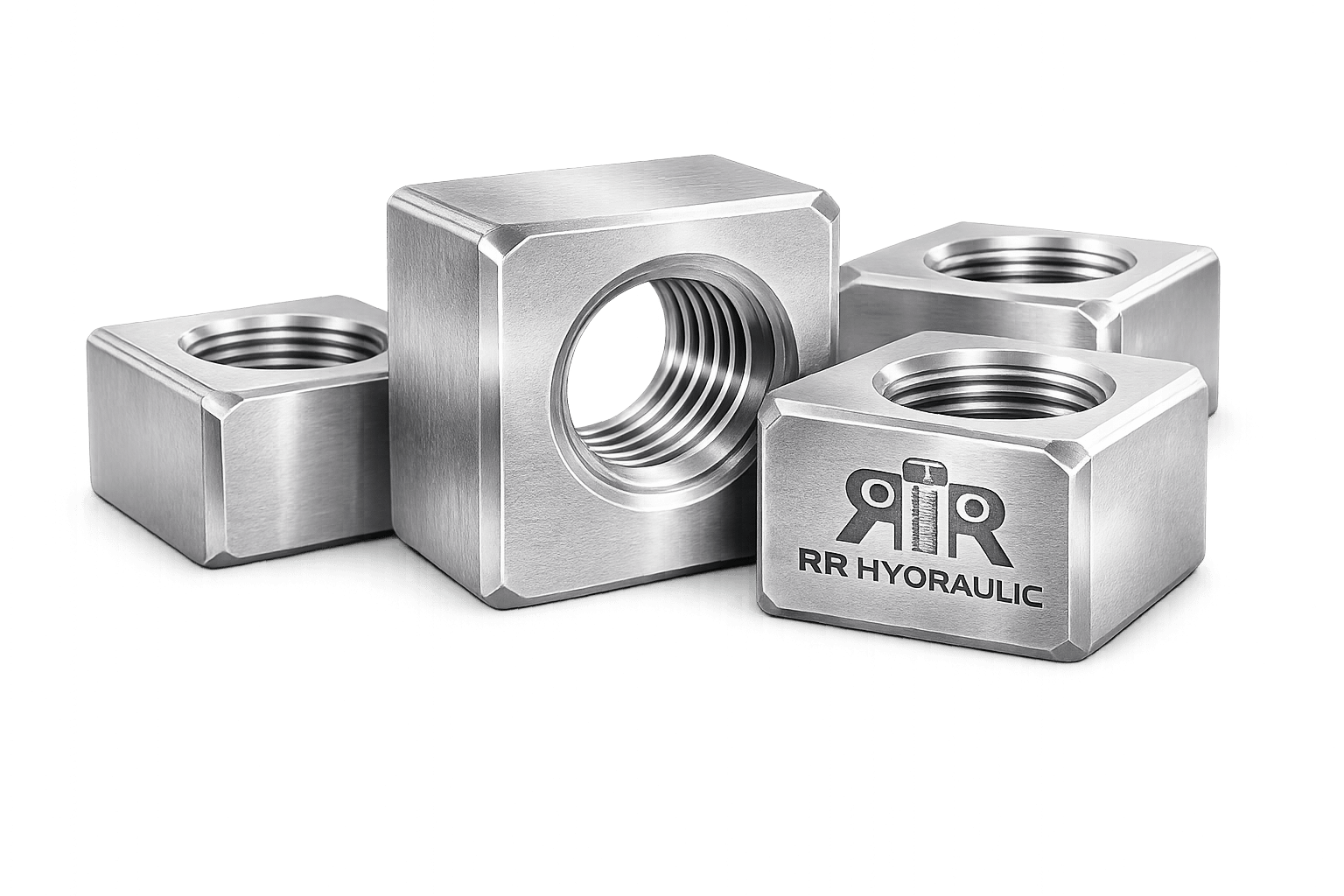
Square Nut Types, Engineering Function
& Governing Standards
T-Slot · Weld · Channel · Machine · Low · Thin Types
Definition and Engineering Function
A square nut is an internally threaded fastener with a four-sided external profile, providing four wrench-engagement faces. The square profile delivers a larger bearing surface-to-thread-diameter ratio compared to a hex nut of equivalent nominal size, making it preferred in applications requiring distributed load over a broader contact area, anti-rotation in channels, T-slots and extrusion grooves, or embedded installation in timber and concrete where the square body provides four-fold anti-rotation resistance over a circular or hex profile.
Square nuts retain specific engineering advantages in: aluminium extrusion assembly (T-slot and channel systems), pipe support and strut channel frameworks (Unistrut/Superstrut), wood and timber construction where the flat side distributes load across grain, anchoring applications in cast-in-place concrete channels, and machine tool tables where T-slot engagement is mandatory. For an M12 square nut (DIN 557), the bearing area under the nut face is approximately 256 mm² compared to approximately 162 mm² for an M12 hex nut (ISO 4032) — a 58% advantage on low-strength substrates.
The square nut's flat-sided geometry presents a larger projected bearing area per unit of width across flats. This reduces localised surface pressure against the mated material, critically important when bearing against timber, aluminium profiles, FRP, plastics and other substrates with low compressive strength perpendicular to surface. In embedded applications, the four corners also resist pull-through and rotation independently of friction.
Square Nut Types — Complete Engineering Descriptions
Governing Standards
DIN 557 is the primary European standard for metric square nuts (M1.6–M36), defining width across flats, nut height, chamfer angle and property class markings. Widely referenced in European EPC project specifications and German machinery standards. ISO 4034 is the current international standard covering M1.6–M36 in property classes 4, 5, 6 and 8. ISO 4034 (full height) and ISO 4035 (chamfered, thin) form the primary international reference pair, ensuring cross-manufacturer dimensional interchangeability.
ASME B18.2.2 covers inch-series square nuts, regular and heavy series, from 1/4" to 1-1/2" UNC. The heavy square nut per B18.2.2 is the standard for structural applications requiring increased bearing area with ASTM A325/A490 bolts. DIN 562 covers thin (low) square nuts. DIN 928 covers square weld nuts with pilot projection. DIN 508 covers T-slot nuts for machine tool applications with the tight h8 or h9 width tolerances essential for smooth slide-fit operation.
| Type | Standard | Height | Property Class | Primary Application |
|---|---|---|---|---|
| Standard Square | DIN 557 / ISO 4034 | ~0.8d | 4, 5, 6, 8 | General fastening, timber, embedded applications |
| Thin / Low Square | DIN 562 / ISO 4035 | ~0.5d | 04, 05 | Jam nut, confined space, light sheet metal |
| T-Slot Nut | DIN 508 / ISO 299 | ~0.5–0.7d | 8 (hardened) | Machine tables, aluminium extrusion fixtures |
| Channel / Strut Nut | Unistrut / OEM spec | ~0.5d | Grade 5 / 8 | Strut channel, pipe support, cable tray |
| Weld Square Nut | DIN 928 / DIN 929 | ~0.8d | 4, 6 | Sheet metal, automotive, enclosure fabrication |
| Machine Square Nut | ASME B18.2.2 / DIN 562 | ~0.8d | 5, 8 | Machine guarding, instrument panels |
| Cast-In / Anchor Nut | ASTM F594 / project spec | 1.5–2.0d | 4, 6 | Concrete foundation anchor, base plate bolting |
| Coupling Square Nut | Custom / DIN 6334 var. | 3.0–4.0d | 6, 8 | Rod coupling, anchor extension, formwork |
| Flange Square Nut | Custom / DIN 6923 var. | ~0.8d | 6, 8 | Timber, through-bolt, no-washer applications |
Dimensional Data, Property Classes
& Torque Reference
ASME B18.2.2 · Property Classes · Torque Chart
Square vs Hex Nut — Key Engineering Differences
| Thread Size | Pitch (mm) | Width Across Flats (mm) | Tolerance (mm) | Nut Height m (mm) | Bearing Area (mm²) | Property Class |
|---|---|---|---|---|---|---|
| M4 | 0.70 | 7.0 | ±0.24 | 3.2 | 34 | 5, 6 |
| M5 | 0.80 | 8.0 | ±0.24 | 4.0 | 49 | 5, 6 |
| M6 | 1.00 | 10.0 | ±0.28 | 5.0 | 72 | 5, 6, 8 |
| M8 | 1.25 | 13.0 | ±0.28 | 6.5 | 117 | 5, 6, 8 |
| M10 | 1.50 | 16.0 | ±0.34 | 8.0 | 178 | 6, 8 |
| M12 | 1.75 | 20.0 | ±0.34 | 10.0 | 256 | 6, 8 |
| M16 | 2.00 | 26.0 | ±0.42 | 13.0 | 432 | 6, 8 |
| M20 | 2.50 | 32.0 | ±0.42 | 16.0 | 654 | 6, 8 |
| M24 | 3.00 | 38.0 | ±0.52 | 19.0 | 924 | 6, 8 |
| M30 | 3.50 | 46.0 | ±0.52 | 24.0 | 1470 | 6, 8 |
| M36 | 4.00 | 55.0 | ±0.62 | 29.0 | 2116 | 6, 8 |
DIN 557:2000 / ISO 4034:2012. Tolerance class A for M1.6–M16; class B for M18–M36. Bearing area = e² − (π×d²/4). Verify current revision for procurement.
| Thread Size | TPI (UNC) | Regular — W/F (in) | Regular — Height (in) | Heavy — W/F (in) | Heavy — Height (in) |
|---|---|---|---|---|---|
| 1/4" | 20 | 7/16 | 7/32 | 1/2 | 1/4 |
| 5/16" | 18 | 9/16 | 17/64 | 5/8 | 17/64 |
| 3/8" | 16 | 5/8 | 21/64 | 3/4 | 21/64 |
| 7/16" | 14 | 3/4 | 3/8 | 7/8 | 3/8 |
| 1/2" | 13 | 13/16 | 7/16 | 1" | 7/16 |
| 5/8" | 11 | 1" | 35/64 | 1-1/4 | 35/64 |
| 3/4" | 10 | 1-1/4 | 41/64 | 1-1/2 | 41/64 |
| 7/8" | 9 | 1-7/16 | 3/4 | 1-3/4 | 3/4 |
| 1" | 8 | 1-5/8 | 55/64 | 2" | 55/64 |
| 1-1/4" | 7 | 2" | 1-3/64 | 2-1/2 | 1-3/64 |
| 1-1/2" | 6 | 2-3/8" | 1-19/64 | 3" | 1-19/64 |
ASME B18.2.2-2010. Heavy square nut width across flats is approximately 25% larger than regular series for the same thread size.
| ISO Class | Proof Load (MPa) | Min. Hardness (HV) | Max. Hardness (HV) | Bolt Pairing | Material |
|---|---|---|---|---|---|
| ISO 4 | 400 | — | 302 | 4.6 / 4.8 | Carbon steel, as-processed |
| ISO 5 | 500 | — | 302 | 4.6 / 5.8 | Carbon steel |
| ISO 6 | 600 | — | 302 | 5.8 / 6.8 | Carbon steel |
| ISO 8 | 800 | 200 | 302 | 8.8 (primary) | Carbon steel Q&T |
| ASTM A563-C | 590 (85.5 ksi) | — | 302 HB | A307 / A325 | Carbon steel |
| ASTM A563-DH | 1034 (150 ksi) | ≥300 HB | — | A490 | Carbon steel Q&T |
| A2-70 | 700 | — | 320 HV | A2-70 bolt | SS 304 |
| A4-70 | 700 | — | 320 HV | A4-70 bolt | SS 316 |
| A4-80 | 800 | — | 320 HV | A4-80 bolt | SS 316L cold-worked |
| Thread | Class | Dry Torque (N·m) | Lubricated (N·m) | Proof Load (kN) | Notes |
|---|---|---|---|---|---|
| M6 | Cl.6 | 9 | 7 | 8.8 | K=0.20 dry / K=0.15 lubricated |
| M8 | Cl.6 | 22 | 16 | 15.3 | |
| M10 | Cl.6 | 44 | 33 | 24.6 | |
| M12 | Cl.6 | 76 | 57 | 36.1 | |
| M16 | Cl.6 | 184 | 138 | 65.9 | |
| M6 | Cl.8 | 12 | 9 | 11.5 | |
| M8 | Cl.8 | 29 | 22 | 20.0 | |
| M10 | Cl.8 | 57 | 43 | 32.0 | |
| M12 | Cl.8 | 99 | 74 | 47.2 | |
| M16 | Cl.8 | 240 | 180 | 86.0 | Verify torque wrench calibration |
| M20 | Cl.8 | 470 | 352 | 133 | |
| M24 | Cl.8 | 816 | 612 | 193 | |
| M30 | Cl.8 | 1640 | 1230 | 308 | Hydraulic torque tool recommended |
| M36 | Cl.8 | 2840 | 2130 | 443 | Hydraulic torque tool required |
T = K × d × F. K=0.20 dry; K=0.15 lubricated (MoS₂ or SAE 30 oil on threads and bearing face). Apply in minimum two stages. Confirm with project bolt calculation.
σ_bearing = F_preload / A_bearing // Bearing stress [MPa] — must not exceed substrate design allowable
// WORKED EXAMPLE: M12 Class 8 square nut on LVL timber, proof load = 47.2 kN
A_bearing = 20² − (π × 13² / 4) = 400 − 133 = 267 mm²
σ_bearing = 47,200 / 267 = 177 MPa // Steel nut face — verify substrate contact stress separately
Material Grades, Mechanical Properties
& Surface Treatments
HDG · Zinc Plate · Black Oxide · Electroless Nickel · Dacromet
| Grade | Standard | UTS (MPa) | Proof Load (MPa) | Hardness | Temp (°C) | Corrosion | Use Case |
|---|---|---|---|---|---|---|---|
| CS Cl.6 | ISO 898-2 | — | 600 | ≤302 HV | −50 to +300 | Low | General structural, machinery, T-slot systems |
| CS Cl.8 | ISO 898-2 | — | 800 | 200–302 HV | −50 to +300 | Low | High-load structural, 8.8 bolt pairing |
| A563 Gr.C | ASTM A563 | — | 590 (85.5 ksi) | ≤302 HB | General | Low | Structural, A307/A325 bolt pairing, inch series |
| A563 Gr.DH | ASTM A563 | — | 1034 (150 ksi) | ≥300 HB | General | Low | Heavy structural, A490 bolt pairing |
| SS 304 (A2-70) | ISO 3506-2 | ≥700 | 700 | ≤320 HV | −196 to +650 | High | Food, pharma, marine-adjacent, chemical |
| SS 316 (A4-70) | ISO 3506-2 | ≥700 | 700 | ≤320 HV | −196 to +650 | Very High | Chloride environments, offshore topside, FGD |
| Duplex 2205 | EN 20898 / ASTM F594 | ≥690 | — | ≤310 HB | −50 to +300 | Very High | Sour gas service, subsea, offshore structures |
| Super Duplex | ASTM F594 | ≥795 | — | ≤310 HB | −50 to +280 | Extreme | High-chloride subsea, severe sour service |
| Brass (CuZn) | BS 2872 / ASTM B16 | ≥310 | — | ~100 HB | −50 to +180 | Good | Electrical panels, plumbing, aluminium extrusion |
| Inconel 625 | ASTM B564 | ≥827 | — | ≤241 HB | −200 to +980 | Extreme | High-temp, corrosive chemical, turbine service |
| Monel 400 | ASTM B164 | ≥482 | — | — | −200 to +480 | High — seawater | Marine, seawater, HF acid environments |
NACE MR0175 / ISO 15156 Sour Service Compliance
Square nuts deployed in sour service environments must comply with the hardness restrictions of NACE MR0175 / ISO 15156 — maximum 22 HRC (237 HB) throughout the full cross-section for carbon and low-alloy steel. This requires controlled heat treatment and full cross-section hardness mapping; surface readings are not sufficient. Duplex and super duplex square nuts must be solution annealed with PREN (pitting resistance equivalent number) verified per batch chemistry documentation per NACE MR0175 Part 3.
| Finish / Coating | Standard | Thickness (µm) | Salt Spray (hrs) | Max Temp (°C) | H₂ Embrittlement | Application |
|---|---|---|---|---|---|---|
| Plain / Bare | — | — | <24 | — | None | Indoor storage; apply VCI for export |
| Black oxide + oil | MIL-DTL-13924 | 0.5–2 | 24–48 | 150 | Negligible | Cosmetic; indoor machinery, T-slot nuts |
| Zinc electroplate SC1 | ASTM B633 SC1 | 5–8 | 96 | 150 | Risk Cl.10+ | Light indoor-outdoor; commercial fasteners |
| Zinc electroplate SC3 | ASTM B633 SC3 | 13 min | 200 | 150 | Moderate risk | General outdoor, structural below 10.9 |
| Hot-dip galvanise | ASTM A153 Class C | 45–86 | 500+ | 200 | None | Structural, outdoor, timber, anchors. Thread overcut per DIN 267-10 required. |
| Mechanical zinc | ASTM B695 Cl.12 | 12 min | 200 | 150 | None | High-strength nuts ≥ Cl.8; no H₂ risk |
| Zinc-nickel alloy | ASTM B841 | 8–15 | 500–1000 | 200 | Low | Offshore-adjacent, marine environments |
| Dacromet / Geomet | ISO 10683 | 8–12 | 720+ | 300 | None | High-strength, high-temp, no H₂ risk |
| Electroless nickel | ASTM B733 SC4 | 25–50 | 300+ | 400 | Negligible | Corrosion + wear resistance, T-slot bores |
| PTFE / Xylan | Whitford spec. | 15–30 | 400+ | 230 | None | Low K-factor (0.08–0.12) for torque control |
Hot-dip galvanised square nuts: thread overcut per DIN 267-10 is mandatory. K-factor for HDG is typically 0.18–0.22 — verify in torque calculations. Standard-thread mating bolts will not engage HDG internal threads without overcut.
Electroplating of square nuts in property class 8 and above introduces atomic hydrogen that can cause delayed brittle fracture. ASTM F1941 requires baking at 190–220°C for minimum 8 hours post-plating for steel fasteners above 39 HRC. For Class 8 square nuts, mechanical zinc (ASTM B695), Dacromet/Geomet or hot-dip galvanising are safe alternatives carrying zero hydrogen embrittlement risk, with superior corrosion protection for structural and outdoor applications.
Inspection, QC Protocols, Applications
& Export Documentation
Structural · T-Slot · Anchor · Channel · Export Packaging
Inspection and Quality Control
Width across flats, nut height, chamfer dimensions and bearing face flatness are verified per DIN 557 / ISO 4034 or ASME B18.2.2 tolerances using calibrated gauges and CMM for critical dimensions. For T-slot nuts per DIN 508, the tight h8 or h9 width tolerance is verified with precision digital calipers and slip gauges. Thread gauging (Go/No-Go per ISO 1502 or ASME B1.2) is performed on every incoming batch — failed Go gauge engagement results in 100% lot rejection.
Proof load testing per ISO 898-2 is the primary mechanical qualification. Hardness testing (Vickers HV per ISO 6507 or Brinell HB per ISO 6506) is performed on minimum one nut per heat. For NACE MR0175 compliance, cross-section hardness mapping (minimum 9-point grid per nut face) is required — surface spot readings are inadequate for sour service qualification. Charpy impact testing at −46°C is required for low-temperature grades.
Type 3.1 is validated by the manufacturer's own authorised inspection representative. Required as minimum for all EPC and OEM project supply. Must state material standard, grade, heat/lot number, chemical analysis, mechanical test results and heat treatment condition. Type 3.2 is co-validated by purchaser-nominated TPI body (Bureau Veritas, DNV, Lloyds, SGS, TÜV). Mandatory for offshore, NACE, nuclear-adjacent and safety-critical structural Class 1 applications.
Positive Material Identification by XRF or OES spectrometry is mandatory for all stainless steel, duplex and super duplex and exotic alloy square nuts to confirm alloy composition matches the MTC. For large mixed-grade orders on EPC projects, PMI is performed at the point of packing to prevent grade mix-up prior to dispatch.
Applications by Industry and Use Case
Heavy square nuts per ASME B18.2.2 in A563 Grade DH are used in structural bolted connections with A490 high-strength bolts where increased bearing area is required on thin flanges and connection plates. In timber-frame construction, hot-dip galvanised DIN 557 square nuts with matching washers are standard for through-bolt connections — the square body provides superior pull-through resistance in timber grain. For anchor bolt assemblies in concrete, oversized cast-in square nuts provide maximum anti-rotation and pull-out resistance of any embedded nut type.
T-slot square nuts per DIN 508 / ISO 299 are mandatory on milling machine tables, precision grinding fixtures, boring mill tables and CNC machining centre pallets. The tight h8 width tolerance ensures smooth sliding fit in standard T-slots without binding. T-slot nuts are supplied in hardened carbon steel (45–55 HRC on sliding surfaces) to resist wear from repeated repositioning on cast iron surfaces.
Spring channel square nuts for Unistrut, Superstrut and Kindorf 41×41 mm strut channel systems are the universal pipe support fastener in industrial, power plant, petrochemical and building services installations. Stainless steel 316 spring channel nuts are specified for corrosive environments including offshore, coastal, food processing and chemical plant service.
Square nuts in oil and gas applications appear in structural framing, equipment base plate anchor systems and cable tray support in process areas. For sour service or offshore locations, duplex 2205 or super duplex square nuts with EN 10204 3.2 MTC, PMI and TPI witness are standard project requirements. NACE MR0175 / ISO 15156 compliance documentation must accompany all nuts in H₂S-present service zones.
Pre-assembly square nuts (hammer nuts, drop-in nuts, roll-in nuts) are designed for T-slots of standard aluminium extrusion profiles (20×20, 30×30, 40×40, 45×45 mm systems from Bosch Rexroth, Item, Misumi and equivalents). The four-sided form prevents rotation when the bolt is engaged. Brass and stainless steel versions are available for clean-room, food-grade and corrosion-sensitive modular frame applications.
Export Packaging and Preservation
- Square nuts packed in heat-sealed polypropylene bags, batch-labelled with PO number, grade, thread size, standard, heat/lot number and quantity
- VCI (Volatile Corrosion Inhibitor) poly liner or VCI paper in each bag for plain/bare finish nuts intended for sea freight or long-term storage
- Bags packed in double-wall corrugated cartons with foam or kraft paper void fill to prevent abrasion and inter-nut contact during transit
- Cartons secured on ISPM-15 heat-treated timber pallets with stretch wrap and minimum two steel strapping bands per pallet layer
- MTC, dimensional inspection report, thread gauge certificate and all project documents in waterproof sealed envelope attached to exterior of each crate
- Outer crate labels: PO number, item tag, material grade, standard, heat number, quantity, gross weight, country of origin, handling instructions
- Silica gel desiccant (30 g per kg of metal) in sealed pouches for premium or long-term storage requirements
| # | Document | Standard / Reference | Minimum Requirement |
|---|---|---|---|
| 01 | Material Test Certificate (MTC) | EN 10204 3.1 / 3.2 | 3.2 for offshore / NACE / nuclear applications |
| 02 | Proof Load Test Report | ISO 898-2 / ASTM A563 §6 | Per heat/lot — mandatory for all structural grades |
| 03 | Hardness Test Report | ISO 6507 / ISO 6506 | Cross-section mapping mandatory for NACE service nuts |
| 04 | Dimensional Inspection Report | DIN 557 / ISO 4034 / B18.2.2 | AQL 1.0 per ISO 2859 on each dispatch batch |
| 05 | Thread Gauge Certificate | ISO 1502 / ASME B1.2 | Go/No-Go per heat lot for project supply |
| 06 | PMI Report (XRF / OES) | Project specification | 100% of SS, duplex, alloy and exotic grades |
| 07 | Chemical Analysis Report | ASTM / ISO grade standard | Included in MTC — verify against grade limits |
| 08 | Heat Treatment Certificate | ISO 898-2 / ASTM A563 §5 | Required for Q&T grades (Class 8, A563 DH) |
| 09 | Surface Finish / Coating Certificate | ASTM A153 / B633 / ISO 10683 | Required for all coated finishes (HDG, ZP, Dacromet) |
| 10 | ISO 9001 Manufacturer Certificate | ISO 9001:2015 | Current; scope must include fastener manufacture |
| 11 | Packing List / Traceability Record | Project MRB format | Heat-number-level traceability to PO line item |
| 12 | ISPM-15 Phytosanitary Certificate | IPPC / FAO | All wood packing for international export |
RR Hydraulics manufactures and exports square nuts in all grades and types — carbon steel, stainless steel 304/316, alloy steel, duplex & super duplex, brass, Inconel and Monel — to DIN 557, ISO 4034, DIN 508, DIN 562, DIN 928, ASME B18.2.2 and project-specific drawings. Full EN 10204 3.1/3.2 MTC documentation, ISO 9001:2015 QMS, TPI witness by BV/DNV/Lloyds/SGS/TÜV accommodated. M4–M36 metric and 1/4"–1-1/2" inch. NACE MR0175-compliant grades with full cross-section hardness certification. 48-hour express dispatch on in-stock sizes.