RFQ Today
Certifications available: EN 10204 3.1 / 3.2 MTRs, NACE MR0175 compliance, Third-Party Inspection witness, ASME / ASTM / DIN standards, full export documentation.
Stud Bolts
A world-class technical reference for EPC contractors, piping and pressure vessel engineers, procurement heads, TPI inspection agencies, and global project buyers specifying stud bolts in high-pressure, high-temperature, and corrosive industrial systems.
Sealing Principles
& Load Characteristics
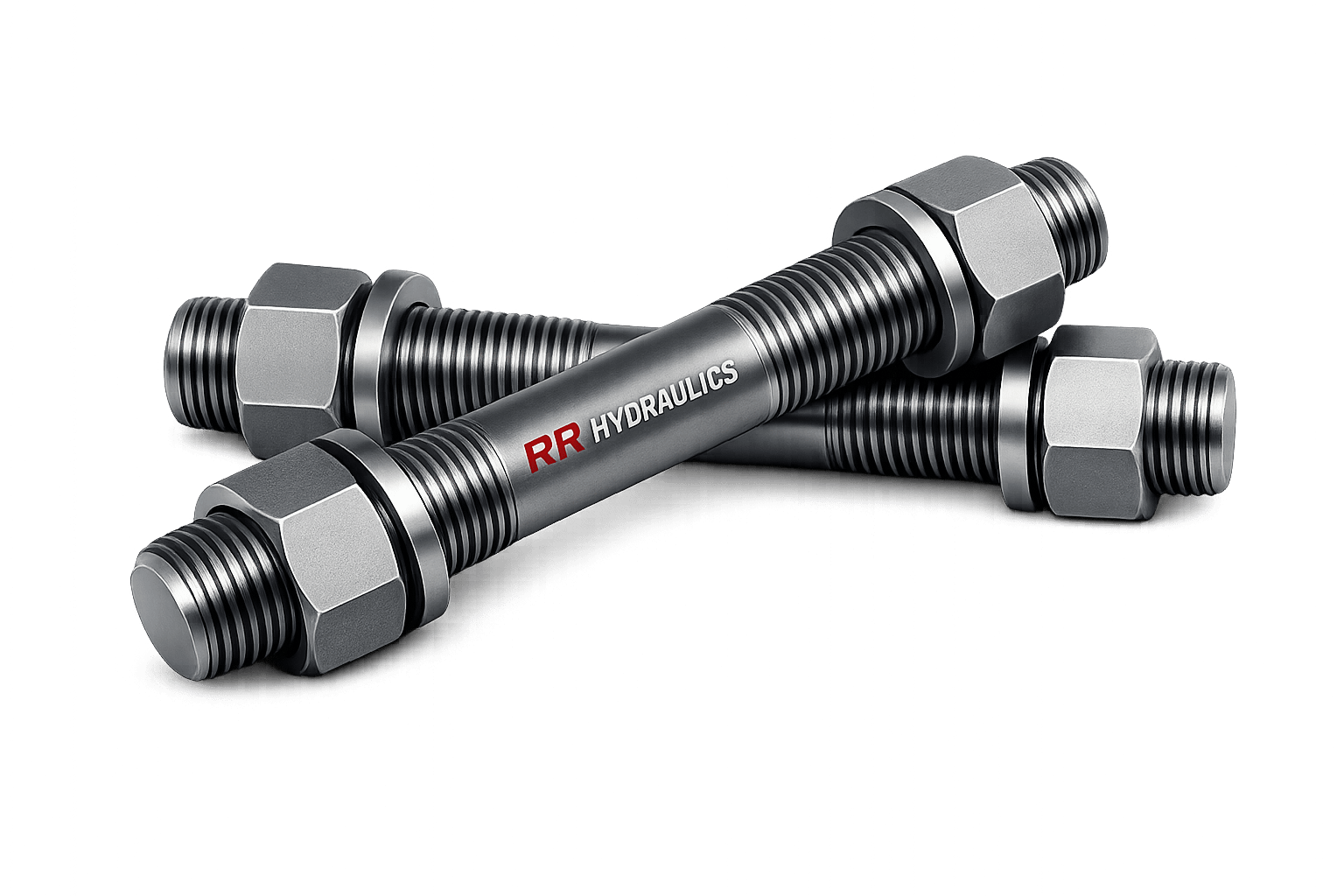
Stud bolts are fully threaded fasteners without a head, engaging nuts at both ends to clamp flanged joints in high-pressure piping, pressure vessels, heat exchangers, and valve bonnets. They are the primary bolting hardware in ASME B16.5 / B16.47 flanged systems and form the structural backbone of pressure-retaining joints in Oil & Gas, LNG, Power, and Petrochemical installations.
1.1 — Technical Definition and Functional Role in EPC Systems
A stud bolt is a headless, continuously threaded rod — typically with full-length thread or defined thread engagement zones at each end — used to clamp two flanged faces together with a heavy hex nut at each end. Unlike bolts (which have an integral head), stud bolts distribute clamping load symmetrically and allow precise torquing from both ends, making them the preferred bolting solution in pressure-retaining flange assemblies per ASME PCC-1, ASME B31.3, and related piping codes.
In EPC projects, stud bolts appear in virtually every flanged connection: wellheads, pipelines, pressure vessel nozzles, heat exchanger channel flanges, valve bodies, compressor cylinders, turbine casings, and instrumentation flanges. The correct specification — covering material grade, dimensional standard, heat treatment, coating, and certification level — is a critical engineering deliverable on every project BOM.
Full-Thread Stud Bolt
Thread continuous along the entire shank length. Standard configuration per ASME B16.5 for Class 150–2500 flanges. Allows nut position to be adjusted along the full length; preferred for standard piping flanges.
Double-End Stud Bolt
Threaded at both ends with a plain (unthreaded) shank in the centre. Thread length at each end equals 1× nominal diameter (or per project specification). Used in high-pressure Class 900–2500 and special flange applications.
Single-End / Tap-End Stud
One end threaded for engagement into a tapped hole in the equipment body (e.g., valve bonnet, pressure vessel flange). The other end accepts a nut. Thread engagement depth into tapped body typically 1.25×d to 1.5×d minimum.
Continuous Thread Rod (CTR)
Full-length threaded rod cut to length; used in low-pressure general construction. Not acceptable as a substitute for precision-machined stud bolts in pressure-retaining service without explicit engineering approval.
Flange Stud Bolt
Precisely manufactured stud bolt with chamfered ends, accurate length per ASME B16.5 bolt dimension tables, and thread per ASME B1.1 (2A class). Supplied with two heavy hex nuts per ASME B18.2.2 / ASTM A194.
High-Pressure / Special Stud
Custom-engineered stud bolts for Class 4500, API 6A, subsea tree, and wellhead applications. May require Inconel, Super Duplex, or exotic alloy materials, with custom thread forms and extended documentation.
1.2 — Role of Stud Bolts in Flanged Joint Sealing
The primary function of stud bolts in a flanged joint is to generate and maintain the gasket seating stress required to prevent leakage under operating pressure. The joint sealing mechanism follows a defined mechanical chain:
- Bolt preload (F_b): Applied torque generates axial bolt load, compressing the gasket between the flange faces.
- Gasket seating: Gasket must be compressed to minimum seating stress (y) to close surface irregularities and achieve initial seal.
- Operating condition: Internal pressure exerts hydrostatic end force that partially unloads the bolts; residual gasket stress must remain above the minimum operating gasket stress factor (m × P) defined in ASME BPVC Section VIII, Div. 1, Appendix 2.
- Preload retention: Embedment relaxation, thermal cycling, and vibration reduce effective preload post-installation; initial preload must include these deductions.
1.3 — Flanged Joint Selection: Stud Bolts vs Alternative Bolting
| Bolting Type | Engagement Method | Load Symmetry | Pressure Class Suitability | Code Preference | Remarks |
|---|---|---|---|---|---|
| Full-Thread Stud + 2 Nuts | Both ends through flange bolt holes | Symmetric | Class 150–2500 | ASME B16.5 preferred | Standard for pressure piping |
| Hex Bolt + 1 Nut | Head bears on one flange face | Asymmetric | Class 150–600 | Acceptable; less common | Not preferred in high-temp cycling |
| Tap-End Stud + 1 Nut | One end into tapped body | Semi-symmetric | Any | Valve bonnets, compressor heads | Engagement depth critical |
| Tension-Controlled Stud | Hydraulic tensioning both ends | Fully symmetric | Class 900–2500 | ASME PCC-1 preferred | Offshore, critical joints |
| Threaded Rod (field cut) | Both ends, nuts | Symmetric | Low pressure only | Not code-compliant for pressure | Never use in rated pressure service |
1.4 — Bolt Preload Behaviour: Embedment, Thermal Cycling & Vibration
Bolt preload loss is inevitable after initial tightening. Engineers must understand the three principal relaxation mechanisms to specify appropriate initial preload targets:
Embedment Relaxation
Surface asperities on thread flanks and under nut bearing faces plastically deform under initial load, reducing effective preload by 5–15% within the first 24–72 hours. Counteracted by re-torquing or initial preload targeting 1.15× design preload.
Thermal Cycling
Differential thermal expansion between stud bolt and flange material causes cyclic preload variation. High-temperature service (above 300°C) requires ASTM A193 B7 or B16 grade with creep-resistant properties. Retorquing at operating temperature is mandatory in some codes.
Vibration Loosening
Transverse vibration (Junker effect) causes progressive nut rotation and preload loss. Mitigated by: achieving target preload (≥75% yield), using prevailing torque nuts, or applying thread locking compounds. Compressor and pump piping connections are high-risk zones.
Gasket Creep Relaxation
Compressed gaskets creep under sustained load, reducing the reaction force on the bolt. Spiral wound and ring-type joint (RTJ) gaskets exhibit less creep than soft gaskets; stud bolt preload targets must account for gasket type relaxation factor.
1.5 — Pressure Cycling Performance and Fatigue
In process plants with frequent startup/shutdown cycles, pressure fluctuations, or thermal transients, stud bolts are subject to cyclic loading. Fatigue life is assessed using Miner’s cumulative damage rule, with stress amplitude at the thread root being the critical location. Thread root stress concentration factor (Kt) for standard UNC threads ranges from 3.0 to 4.5.
b = effective gasket seating width (mm)
G = mean gasket diameter (mm)
y = minimum design seating stress for gasket type (MPa)
Operating condition bolt load:
W_m1 = H + H_p = (π/4 × G² × P) + (2b × π × G × m × P)
G = 168.3 mm, b = 6.3 mm, P = 10 MPa (operating), m = 3.0, y = 69 MPa
W_m2 = 6.3 × π × 168.3 × 69 = 229,800 N = 229.8 kN
W_m1 = (π/4 × 168.3² × 10) + (2 × 6.3 × π × 168.3 × 3.0 × 10) = 222,480 + 199,800 = 422,280 N
Design bolt load governs at W_m1 = 422.3 kN → distribute across 8 stud bolts → 52.8 kN per bolt.
Submit your flange class, material specification, and quantity for a documented RFQ within 24 hours.
Pressure Classes
& Standards Compliance
Stud bolt dimensions are governed by ASME B16.5, ASME B16.47, ASME B1.1, DIN 976, and ISO 898-1. Each pressure class and flange size combination defines a specific stud bolt diameter, thread pitch, and nominal length. Non-compliance with dimensional tables results in joint under-loading and code non-compliance.
Submit grade, flange class, size, and quantity to sales@rrhydraulics.com for a certified commercial offer.
2.1 — ASME B16.5 Stud Bolt Dimensional Table (Class 150–2500)
The following table provides representative stud bolt nominal dimensions per ASME B16.5 for raised-face (RF) and ring-type joint (RTJ) flanges. All lengths are nominal; actual length is determined by flange thickness + gasket thickness + nut height × 2 + 2 thread pitches protruding beyond each nut.
| Flange Size (NPS) | Class 150 Bolt Ø × Length (in) | Class 300 Bolt Ø × Length (in) | Class 600 Bolt Ø × Length (in) | Class 900 Bolt Ø × Length (in) | Class 1500 Bolt Ø × Length (in) | Class 2500 Bolt Ø × Length (in) | No. of Bolts |
|---|---|---|---|---|---|---|---|
| ½” | ½ × 3½ | ½ × 3½ | ½ × 3½ | ¾ × 4 | ¾ × 4½ | ¾ × 5 | 4 |
| 1″ | ½ × 3½ | ⅝ × 4 | ⅝ × 4½ | ⅞ × 5 | ⅞ × 5½ | 1 × 6½ | 4 |
| 2″ | ⅝ × 3¾ | ¾ × 4½ | ¾ × 5½ | 1 × 6½ | 1⅛ × 7 | 1¼ × 9 | 8 |
| 3″ | ⅝ × 4 | ¾ × 5 | ⅞ × 6 | 1⅛ × 7½ | 1¼ × 8½ | 1½ × 11 | 8 |
| 4″ | ⅝ × 4 | ¾ × 5 | 1 × 6½ | 1¼ × 8½ | 1½ × 10 | 1¾ × 13 | 8 |
| 6″ | ¾ × 4½ | ¾ × 5½ | 1⅛ × 7½ | 1⅜ × 9½ | 1¾ × 12 | 2 × 15½ | 12 |
| 8″ | ¾ × 4½ | ⅞ × 5½ | 1¼ × 8 | 1½ × 11 | 2 × 14 | 2¼ × 18 | 12 |
| 10″ | ⅞ × 5 | 1 × 6 | 1⅜ × 9 | 1¾ × 12½ | 2¼ × 16 | 2½ × 21 | 16 |
| 12″ | ⅞ × 5 | 1⅛ × 6½ | 1½ × 10 | 2 × 14 | 2½ × 18 | 2¾ × 23 | 20 |
| 16″ | 1 × 5½ | 1¼ × 7½ | 1¾ × 12 | 2¼ × 16½ | 3 × 22 | — | 20–28 |
| 20″ | 1⅛ × 6 | 1¼ × 8 | 2 × 14 | 2½ × 19 | — | — | 24–32 |
| 24″ | 1¼ × 6½ | 1½ × 9 | 2¼ × 16 | 3 × 22 | — | — | 24–36 |
2.2 — Pressure Rating Table: ASME B16.5 Classes vs Temperature
Pressure–temperature ratings per ASME B16.5 are a function of flange material group. The following table shows maximum allowable non-shock working pressure (MAWP) for Group 1.1 (ASTM A105 / A216 WCB equivalent) flanges — the most common piping material group. Stud bolt selection must support the rated MAWP at the specified operating temperature.
| Temperature (°C) | Class 150 | Class 300 | Class 600 | Class 900 | Class 1500 | Class 2500 |
|---|---|---|---|---|---|---|
| −29 to 38 | 19.6 | 51.1 | 102.1 | 153.2 | 255.3 | 425.5 |
| 50 | 19.2 | 50.1 | 100.2 | 150.4 | 250.6 | 417.7 |
| 100 | 17.7 | 46.6 | 93.2 | 139.8 | 233.0 | 388.3 |
| 150 | 15.8 | 45.1 | 90.2 | 135.3 | 225.5 | 375.8 |
| 200 | 13.8 | 43.8 | 87.6 | 131.4 | 219.0 | 365.0 |
| 250 | 12.1 | 41.9 | 83.8 | 125.7 | 209.5 | 349.2 |
| 300 | 10.2 | 39.8 | 79.6 | 119.4 | 199.0 | 331.6 |
| 350 | 8.4 | 38.6 | 77.2 | 115.8 | 193.0 | 321.7 |
| 400 | 6.5 | 36.5 | 73.0 | 109.5 | 182.5 | 304.2 |
| 450 | 5.1 | 31.6 | 63.2 | 94.8 | 158.0 | 263.3 |
| 500 | — | 26.5 | 53.0 | 79.5 | 132.5 | 220.8 |
2.3 — Applicable Standards and Compliance Framework
ASTM A193
Primary standard for alloy steel and stainless steel bolting materials for high-temperature service. Grade B7 (4140/4142 alloy steel, Q&T) is the most widely specified grade for Carbon Steel pressure piping. Grade B8/B8M covers SS 304/316 bolting.
ASTM A320
Alloy steel and stainless steel bolting for low-temperature service. Grade L7 (4140 alloy, impact tested) and L43 for cryogenic piping. Charpy impact testing at −101°C for LNG service grades. Mandatory for flanges below −29°C.
ASTM A194
Standard for carbon and alloy steel nuts for bolting at high-pressure or high-temperature service. Grade 2H heavy hex nut is the standard companion to A193 B7 stud bolts. Grade 8 / 8M for stainless pairings.
ASME B16.5
Pipe Flanges and Flanged Fittings, NPS ½ through NPS 24. Defines stud bolt dimensions, number, and grade requirements for each flange class and size combination. The primary dimensional reference for piping stud bolt procurement.
ASME B16.47
Large Diameter Steel Flanges, NPS 26 through NPS 60. Series A (MSS SP-44) and Series B (API 605) — different bolt circle and bolt diameter conventions. Stud bolt dimensions differ from B16.5; always verify series before ordering.
DIN 976 / DIN 939
German standards for metric threaded studs. DIN 976 covers continuous thread studs; DIN 939 covers studs with different thread engagements at each end. Used in European EPC projects and equipment manufactured to DIN/EN piping codes.
ISO 898-1
Mechanical properties of fasteners — bolts, screws, and studs. Defines property classes 4.6 through 12.9 for metric fasteners. Cross-referenced with DIN standards for metric stud bolt supply in European and Asian EPC projects.
ASME PCC-1
Guidelines for Pressure Boundary Bolted Flange Joint Assembly. Specifies bolt tightening sequences, target preload levels, torque or tension methodology, and retorquing requirements for pressure-retaining flange joints in ASME-coded systems.
NACE MR0175 / ISO 15156
Materials for use in H₂S-containing environments in oil and gas production. Defines hardness limits for carbon and low-alloy steel stud bolts in sour service: maximum 22 HRC (237 HB) for A193 B7. Mandatory for all sour service bolting specifications.
2.4 — Thread Form and Compatibility Reference
| Thread System | Standard | Size Range | Pitch / TPI | Tolerance Class | Regional Application | Remarks |
|---|---|---|---|---|---|---|
| UNC (Unified Coarse) | ASME B1.1 | ¼”–4″ | 4–20 TPI | 2A/2B (std); 3A/3B (precision) | USA, Canada, global ASME | Standard for ASME B16.5 stud bolts |
| UNF (Unified Fine) | ASME B1.1 | ¼”–1½” | 12–28 TPI | 2A/2B | Precision, small bore | Rare for standard flanges |
| Metric Coarse (ISO) | ISO 261 / DIN 13 | M6–M100 | 1.0–6.0 mm | 6g/6H | Europe, Asia, DIN-coded plants | DIN 976 / DIN 939 studs |
| Metric Fine | ISO 261 | M8–M52 | 0.75–3.0 mm | 6g/6H | High-pressure German equipment | Must specify; not interchangeable |
| BSW (Whitworth) | BS 84 | ⅛”–4″ | 2.5–28 TPI | Class 1–3 | UK legacy, BS-coded systems | Not interchangeable with UNC |
| ACME / Trapezoidal | ASME B1.5 / DIN 103 | Custom | Project-specific | Class 2G | Valve stems, actuators | Not used for flange stud bolts |
2.5 — Torque Chart: Stud Bolt Installation
| Bolt Ø (in) | TPI (UNC) | Stress Area (in²) | Target Preload (kN) @ 50% Yield | Dry Torque (Nm) | Lubricated Torque (Nm) K=0.15 | MoS₂ Torque (Nm) K=0.12 | ASME B16.5 Class Range |
|---|---|---|---|---|---|---|---|
| ½” | 13 | 0.1419 | 59.3 | 95 | 71 | 57 | 150–600 |
| ⅝” | 11 | 0.2260 | 94.4 | 190 | 143 | 114 | 150–900 |
| ¾” | 10 | 0.3340 | 139.5 | 338 | 254 | 203 | 150–1500 |
| ⅞” | 9 | 0.4620 | 193.0 | 543 | 407 | 326 | 300–1500 |
| 1″ | 8 | 0.6060 | 253.2 | 814 | 610 | 488 | 300–2500 |
| 1⅛” | 8 | 0.7630 | 318.8 | 1153 | 864 | 692 | 600–2500 |
| 1¼” | 8 | 0.9690 | 404.8 | 1625 | 1218 | 975 | 600–2500 |
| 1½” | 8 | 1.4050 | 586.9 | 2837 | 2127 | 1702 | 900–2500 |
| 1¾” | 8 | 1.9000 | 793.8 | 4450 | 3338 | 2670 | 1500–2500 |
| 2″ | 8 | 2.5000 | 1044.8 | 6720 | 5040 | 4032 | 2500 |
| 2¼” | 8 | 3.2500 | 1358.3 | 9808 | 7356 | 5885 | 2500 / special |
| 2½” | 8 | 3.9500 | 1650.5 | 13260 | 9945 | 7956 | Special / API |
2.6 — Preload Calculation Guide
T = Applied tightening torque (Nm)
K = Nut factor / torque coefficient (dimensionless) — see table above
d = Nominal bolt diameter (m)
Target preload range: 50–70% of bolt yield load = A_s × S_y × 0.50 to 0.70
A_s = stress area (m²); S_y = yield strength (Pa)
d = 0.0254 m, K = 0.12, T = 488 Nm
F_b = 488 / (0.12 × 0.0254) = 488 / 0.003048 = 160,105 N ≈ 160.1 kN
B7 Yield = 723 MPa; A_s = 390.9 mm²; Yield Load = 282.6 kN
Preload % of Yield = 160.1 / 282.6 = 56.6% ✓ (within 50–70% target)
Heat Treatment
& Manufacturing
Stud bolt material selection is the most consequential procurement decision in bolted flange engineering. RR Hydraulic manufactures stud bolts in all standard and exotic grades, including ASTM A193 B7/B8/B8M, A320 L7/L43, duplex, super duplex, Inconel, and Hastelloy — with full heat treatment documentation and NACE compliance.
3.1 — Material Grade Overview and Selection Logic
| Grade | ASTM Spec | UTS (MPa) | Yield (MPa) | Elong. (%) | Temp Range (°C) | Hardness Max (HRC) | Primary Service |
|---|---|---|---|---|---|---|---|
| B7 | A193 Gr.B7 | 860–1000 | 723 min | 16 | −45 to +454 | 35 (26 NACE) | Standard CS piping, most common grade |
| B7M | A193 Gr.B7M | 690–862 | 552 min | 18 | −45 to +454 | 22 (NACE compliant) | Sour service, H₂S environments |
| L7 | A320 Gr.L7 | 860 min | 723 min | 16 | −101 to +343 | 35 | Low-temperature, LNG, cryogenic |
| L7M | A320 Gr.L7M | 690–862 | 552 min | 18 | −101 to +343 | 22 (NACE) | Sour + low-temp combined service |
| B8 Cl.1 | A193 Gr.B8 Cl.1 | 515 min | 205 min | 30 | −254 to +816 | — | SS 304 — corrosive, high-temp |
| B8M Cl.2 | A193 Gr.B8M Cl.2 | 690 min | 414 min | 12 | −254 to +816 | — | SS 316 strain-hardened, high strength |
| B8T | A193 Gr.B8T | 515 min | 205 min | 30 | −200 to +900 | — | SS 321 — high-temp stabilised |
| Duplex S31803 | A182 F51 | 620 min | 450 min | 25 | −50 to +315 | 28 max | Offshore, subsea, sour+chloride |
| Super Duplex S32750 | A182 F53 | 750 min | 550 min | 20 | −50 to +260 | 32 max | Seawater, high Cl⁻, HISC-sensitive |
| B80A (Alloy 718) | A193 Gr.B80A | 1241 min | 1034 min | 12 | −254 to +650 | — | High-temp, critical bolting, sour |
3.2 — Yield Strength and Mechanical Properties Reference
| Grade / Spec | Heat Treatment | UTS (MPa) | 0.2% Yield (MPa) | Elongation (%) | Reduction of Area (%) | Hardness (HB) | Charpy CVN @ −45°C (J) |
|---|---|---|---|---|---|---|---|
| A193 B7 (<2½”) | Q&T 860°C/620°C | 860–1000 | 723 | 16 | 50 | 248–302 | 54 (not req.) |
| A193 B7 (2½”–4″) | Q&T 860°C/600°C | 793–965 | 655 | 15 | 50 | 233–285 | — |
| A193 B7M | Q&T (max hardness) | 690–862 | 552 | 18 | 50 | 200–235 | — |
| A320 L7 | Q&T, impact tested | 860 min | 723 | 16 | 50 | 248–302 | 20 min @ −101°C |
| A320 L43 | Q&T, impact tested | 860 min | 655 | 16 | 50 | 248–302 | 20 min @ −101°C |
| A193 B8 Cl.1 | Solution Annealed | 515 | 205 | 30 | 50 | Max 192 | — (austenitic) |
| A193 B8M Cl.2 | Solution Ann. + Strain Hard. | 690 | 414 | 12 | 35 | 260–321 | — |
| Duplex 2205 | Solution Annealed | 620 | 450 | 25 | 45 | Max 293 | — |
| Super Duplex S32750 | Solution Annealed | 750 | 550 | 20 | 40 | Max 310 | — |
3.3 — Corrosion Resistance by Material vs Service Media
| Material | H₂S Sour* | CO₂ / Wet | Cl⁻ / Seawater | HCl (dilute) | Alkaline | High Temp (>400°C) | Atmosphere (Offshore) |
|---|---|---|---|---|---|---|---|
| A193 B7 (HDG/PTFE) | Conditional* | Fair | Poor | Poor | Good | Good to 454°C | Fair |
| A193 B7M (NACE) | Good* | Fair | Poor | Poor | Good | Good to 454°C | Fair |
| A193 B8 (SS 304) | Fair | Good | Poor (SCC risk) | Fair | Very Good | Good to 816°C | Good |
| A193 B8M (SS 316) | Good | Very Good | Fair | Good | Very Good | Good to 816°C | Very Good |
| Duplex 2205 | Very Good | Excellent | Very Good | Very Good | Very Good | Limited >315°C | Excellent |
| Super Duplex S32750 | Excellent | Excellent | Excellent | Excellent | Excellent | Limited >260°C | Excellent |
| Inconel 625 | Excellent | Excellent | Excellent | Excellent | Excellent | Excellent to 980°C | Excellent |
| Hastelloy C-276 | Excellent | Excellent | Excellent | Excellent | Excellent | Excellent to 1090°C | Excellent |
* Sour service compliance requires hardness ≤22 HRC per NACE MR0175 / ISO 15156. B7 standard hardness (up to 35 HRC) is NOT acceptable for sour service without B7M designation.
3.4 — Manufacturing Process
3.4.1 — Bar Stock vs Forging
Stud bolts are manufactured from hot-rolled or cold-drawn bar stock conforming to ASTM A193 raw material requirements. Unlike structural bolts, stud bolts for pressure service are not forged — they are precision CNC-machined from bar stock, with threads cut or rolled to dimensional specification.
3.4.2 — CNC Machining Tolerances
- Thread form: ASME B1.1, Class 2A (standard); Class 3A on request for precision joints
- Thread pitch diameter tolerance: per ASME B1.1 Table 3 for Class 2A
- Nominal length tolerance: +0 / −½ pitch (per ASME B16.5 bolt length tables)
- Straightness: max 0.5 mm per 300 mm of length (measured on surface plate)
- Chamfer at thread ends: 15°–30° from shank axis; minimum 1 full thread depth
- Surface finish of shank: Ra ≤ 3.2 µm; thread form Ra ≤ 1.6 µm
- Concentricity of thread axis to shank: max 0.1 mm TIR for studs >25 mm diameter
3.5 — Surface Finish Options
| Finish | Specification | Thickness (µm) | Salt Spray Resistance (h) | Max Temp (°C) | Effect on K Factor | Typical Application |
|---|---|---|---|---|---|---|
| Plain / Bare | ASTM A193 standard | — | <24 | 454 | K=0.20 (dry) | Torqued immediately; assembly lube applied |
| Black Phosphate | MIL-DTL-16232 | 5–15 | 24–72 | 150 | K=0.15–0.17 | Short-term storage; standard CS studs |
| Zinc Electroplate | ASTM B633 Type II | 5–25 | 96–200 | 120 | K=0.18–0.20 | General EPC, indoor service |
| Hot Dip Galvanize (HDG) | ASTM A153 / ISO 1461 | 45–85 | 2000+ | 200 | K=0.20–0.22 (over-size nut required) | Outdoor, marine atmosphere; HDG nut pair required |
| PTFE / Teflon Coat | Proprietary / ASTM | 20–50 | 1000+ | 260 | K=0.10–0.12 | Precise torque control; flange assembly |
| Molykote / MoS₂ | Applied at assembly | — | — | 450 | K=0.11–0.13 | High-temperature flange assembly standard |
| Geomet / Dacromet | ISO 10683 | 8–12 | 1000–1500 | 300 | K=0.13–0.16 | Offshore deck hardware; EPC outdoor service |
| Passivation (SS/Duplex) | ASTM A380 / A967 | Passive layer | 500–2000+ | Per alloy grade | K=0.20 | All stainless and duplex grade studs |
Industry Applications
& Documentation
RR Hydraulic maintains end-to-end traceability from raw material heat to final packed shipment. All stud bolt orders include dimensional inspection reports, EN 10204 MTRs, and full EPC documentation packages. Third-party inspection by SGS, Bureau Veritas, and Lloyds is coordinated on request.
4.1 — Inspection & NDT Protocol
4.2 — EN 10204 Material Test Certificate Requirements
| Certificate | Content | Signatory | Standard EPC Requirement | When Mandatory |
|---|---|---|---|---|
| 2.1 | Conformity declaration only | Manufacturer | Non-critical utility lines | General procurement only |
| 2.2 | Non-specific test results | Manufacturer | Low-pressure, non-coded service | Rarely accepted in EPC O&G |
| 3.1 | Heat-specific mechanical + chemical results; traceable to production lot | Manufacturer’s authorised QC Inspector | Standard minimum for all pressure service | All Class 150+ stud bolt supply |
| 3.2 | Same as 3.1 + countersigned by independent TPI (SGS / BV / Lloyds / DNV) | Manufacturer + TPI Inspector | Critical joints, NACE service, offshore | Class 900+, sour service, cryogenic |
4.3 — Pressure Test Protocol for Assembled Joints
Stud bolts themselves are not hydrotested individually; hydrostatic / pneumatic testing is performed on the assembled flange system. Post-assembly leak test requirements for pressure piping joints per ASME B31.3:
- Hydrostatic test pressure: 1.5 × MAWP at test temperature (per ASME B31.3 Cl. 345)
- Pneumatic test pressure: 1.1 × MAWP (where hydrostatic not practical)
- Sensitive leak test: 0.1 × MAWP, min 105 kPa (Category D fluid service)
- Hold time: Minimum 10 minutes at test pressure before inspection
- Acceptance: No visible leaks at any joint, including stud bolt threads and nut faces
- NACE sour service: Post-hydrostatic drying mandatory to prevent wet H₂S exposure; stud bolts must be retorqued after drying per ASME PCC-1
4.4 — First Article Inspection (FAI)
A First Article Inspection is conducted on the first production unit of each unique stud bolt configuration (grade + size + thread + finish + standard combination) on new project orders. The FAI report documents: dimensional compliance to all drawing callouts, thread gauge results, hardness readings, visual inspection results, surface finish measurement, and cross-reference to raw material MTC. FAI release is required before batch production proceeds.
4.5 — Applications by Industry
Oil & Gas — Upstream / Wellhead
API 6A wellhead and Xmas tree bolting. High-pressure Class 2000–20000 psi service. Sour service NACE compliance mandatory. Typically Inconel 718 (B80A) or Super Duplex for subsea tree bolting. Full EN 10204 3.2 documentation with TPI witness required.
Refinery / Petrochemical
ASME B31.3 process piping stud bolts. Grade A193 B7 / B7M for most services; B8M for acid and chloride-containing streams. High-temperature catalytic reformer and hydrocracker service requires B16 (2¼Cr-1Mo) or B7 with creep assessment above 370°C.
LNG Terminals
Cryogenic piping in ASTM A320 L7 or L7M for service temperatures down to −165°C. Charpy impact testing at −196°C on special project specifications. All stud bolts supplied with Austenitic SS or aluminium-coated surfaces to prevent galling at cryogenic temperatures.
Power Generation
Steam turbine casing, boiler pressure vessel, and feedwater heater stud bolts. High-temperature grades: A193 B16 (Cr-Mo-V, to +593°C) and B7 (to +454°C). Retorquing at operating temperature required on high-temperature joints per OEM specification.
Offshore / Subsea
Topside piping in SS 316 or Duplex 2205 for marine atmosphere resistance. Subsea tree and manifold bolting in Super Duplex S32760 or Inconel 625. HISC (Hydrogen Induced Stress Cracking) assessment mandatory for super duplex in cathodic protection zones.
Hydrogen Service
Emerging critical application. Stud bolt material must comply with API 941 (Nelson Curves) for high-temperature hydrogen service to prevent HTHA (High-Temperature Hydrogen Attack). Austenitic SS grades (B8 / B8M) and nickel alloys preferred. Carbon and alloy steel require careful temperature-hydrogen partial pressure assessment.
4.6 — Export Packaging and Documentation
4.6.1 — Export Packaging Specification
- Individual stud bolts wrapped in VCI (Volatile Corrosion Inhibitor) poly film — prevents rust formation during ocean freight and warehouse storage periods up to 24 months
- Thread end protection: plastic thread protector caps on both ends of all stud bolts; prevents thread damage during transit and handling
- Bundle tagging: each bundle labelled with heat number, material grade, ASTM standard, size, length, quantity, and PO reference — full traceability maintained through shipping chain
- Inner box / polybag: per size and lot — segregated by heat to prevent mixing during goods receipt inspection at site
- Outer crating: ISPM-15 heat-treated pine wooden crates for all export shipments; crate dimensions optimised to standard container loading
- Crate stencilling: Project PO, Item tag, NDE status, gross weight, net weight, dimensions (L×W×H), country of origin, “THIS SIDE UP” and fragile handling symbols per ASTM D5276
- Packing list enclosed inside lid and externally attached in waterproof envelope; cross-referenced to MTC certificate numbers
4.6.2 — Full EPC Project Documentation Package
| # | Document | Standard / Format | Mandatory / Conditional |
|---|---|---|---|
| 01 | Material Test Certificate (MTC) | EN 10204 3.1 / 3.2 | Mandatory — all pressure service |
| 02 | Chemical Composition Report | Heat/lot certified lab analysis | Mandatory (within MTC) |
| 03 | Mechanical Properties Report | Tensile, yield, elongation, RA, hardness | Mandatory (within MTC) |
| 04 | Hardness Test Report | Per ASTM E10 / E18; Brinell + Rockwell | Mandatory — NACE / sour service |
| 05 | Charpy Impact Test Report | ASTM A370 / EN 10045 | Mandatory — A320 / cryogenic service |
| 06 | Dimensional Inspection Report | Per ASME B1.1 / drawing dimensions | Mandatory |
| 07 | Thread Gauge Inspection Report | Go / No-Go per ASME B1.1 Class 2A | Mandatory |
| 08 | First Article Inspection (FAI) Report | Project-specific format | Mandatory — new item / first batch |
| 09 | MPI / LPI Report | ASTM E709 / E165 / EN ISO 9934 | Conditional — NACE, Class 900+ |
| 10 | PMI Report (XRF) | Per lot; all SS / duplex / exotic grades | Mandatory — non-CS grades |
| 11 | TPI Witness Certificate | SGS / BV / Lloyds / DNV countersigned | Mandatory — EN 10204 3.2 orders |
| 12 | NACE MR0175 Compliance Statement | Hardness + heat treatment confirmation | Mandatory — sour service supply |
| 13 | ISO 9001:2015 Certificate | Third-party QMS certification | Mandatory — EPC projects |
| 14 | Country of Origin Certificate | Chamber of Commerce issued | Mandatory — all export |
| 15 | Packing List | Per shipment; item-level detail | Mandatory |
| 16 | Commercial Invoice | Per INCOTERMS 2020 | Mandatory |
| 17 | Bill of Lading / Air Waybill | Per freight mode | Mandatory |
| 18 | MSDS / Safety Data Sheet | For coated / treated surfaces | Conditional — HDG, PTFE, Geomet |
4.7 — ISO and Quality System Compliance
ISO 9001:2015
Quality Management System covering design review, supplier qualification, in-process control, inspection, and traceability. Mandatory qualification criterion for all EPC and O&G project procurement. RR Hydraulic holds current ISO 9001:2015 certification.
ISO 10474
Steel and steel products — inspection documents. The framework document from which EN 10204 certificate types are derived. Legacy project specifications may reference ISO 10474; EN 10204 is the operative current equivalent.
ISO 9606
Qualification testing of welders for fusion welding. Applicable to facilities manufacturing stud bolt assemblies where any weld-on inserts or structural attachments are included. All welders hold current qualification per ISO 9606-1.
ASME PCC-1
Guidelines for Pressure Boundary Bolted Flange Joint Assembly. Defines best practice for torque sequencing (cross-bolt pattern), target preload as % of yield, lubricant use, and documentation of flange assembly activities on ASME-coded systems.
Submit your BOM, flange class schedule, or material specification to RR Hydraulic for a complete, documented commercial offer.