Submit an R.F.Q. — Lock Nuts
Technical sales team responds within 24 hours. EPC & project pricing across all lock nut types, grades and sizes.
R.F.Q. Submitted Successfully
Our technical team will contact you within 24 hours.
Reference: sales@rrhydraulics.com
Lock Nuts
A comprehensive engineering reference for EPC contractors, mechanical engineers, procurement heads and TPI agencies covering lock nut types, vibration-resistance mechanisms, installation methods, dimensional standards, property classes, material grades, surface treatments and full project documentation.
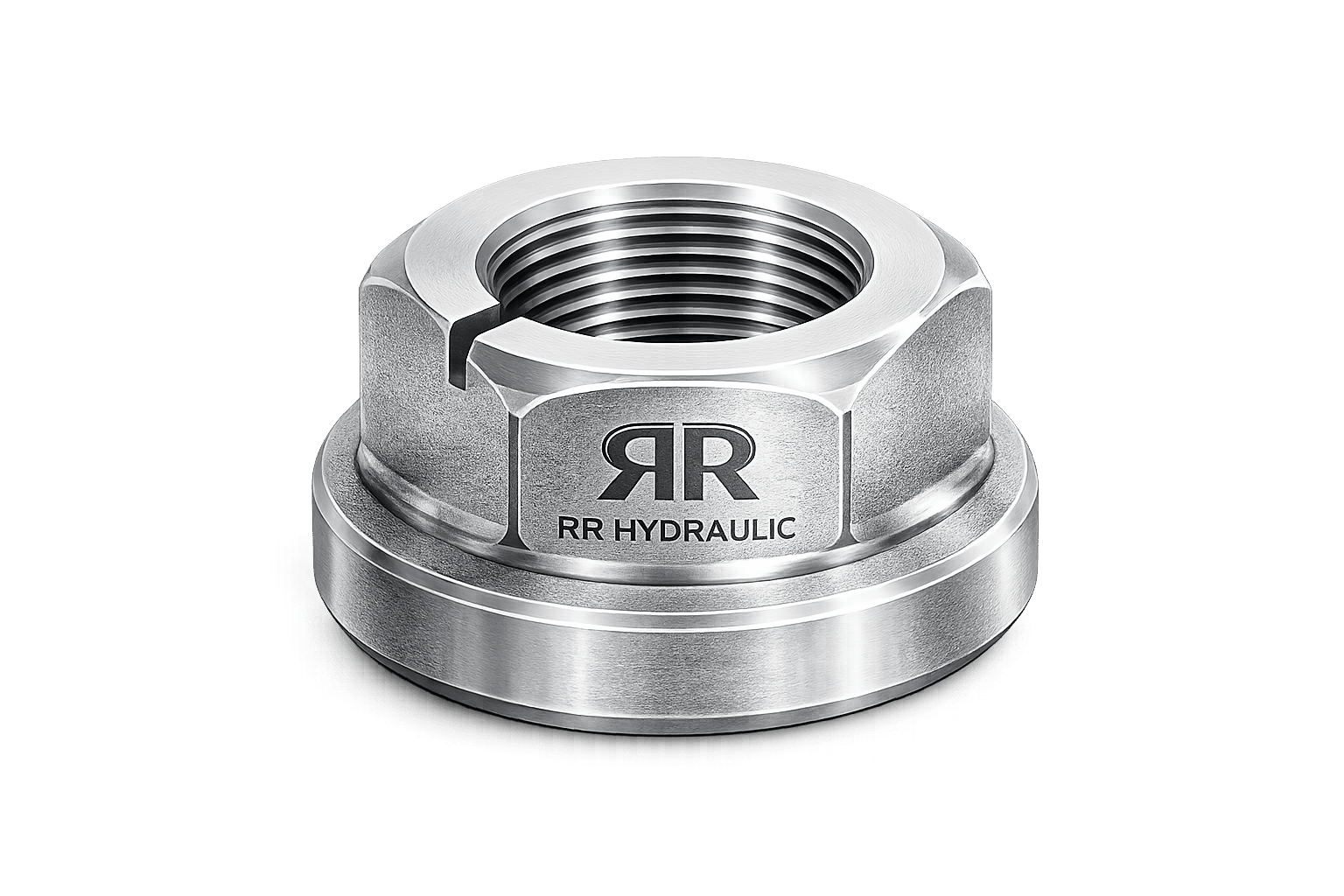
Lock Nut Types, Vibration-Resistance Mechanisms
& Engineering Selection
Nyloc · All-Metal · Prevailing Torque · Serrated Flange · Castellated
Self-Loosening Mechanics and Lock Nut Engineering Principles
Bolt self-loosening under vibration is one of the most well-documented failure modes in mechanical engineering, responsible for a disproportionate share of industrial accidents, equipment failures and unplanned maintenance. The self-loosening mechanism, characterised by Gerhard Junker in the 1960s and formalised in DIN 65151, occurs when cyclic transverse (lateral) loading between the clamped joint members overcomes the thread friction that holds the nut stationary — producing incremental rotational back-off of the nut with each load cycle until the joint is loose. Critically, self-loosening does not require axial vibration: transverse loads perpendicular to the bolt axis are the primary driver.
Lock nuts interrupt the self-loosening mechanism through one of three engineering approaches. Prevailing torque (friction-based): the nut thread is permanently deformed or obstructed (polymer insert or metal deformation) so that an additional resisting torque must be overcome in both the tightening and loosening directions, regardless of joint preload. Direct tension indicators and locking geometries (interface-based): serrations, raised ridges or deformed faces bite into the bearing surface and resist rotation through mechanical interlock rather than thread friction. Positive mechanical retention (pin-and-slot): a cotter pin, safety wire or clip physically prevents rotation, providing a fail-safe locking mechanism independent of friction or preload.
The Junker vibration test (DIN 65151 / ISO 16130) is the industry-standard qualification method for lock nut effectiveness. The fastened joint is subjected to cyclic transverse displacement (typically ±0.65 mm at 12.5 Hz) while bolt clamp load is continuously measured. A standard hex nut typically loses all clamp load within 10–30 vibration cycles. A properly specified and installed lock nut must retain a defined minimum percentage of its initial clamp load (typically ≥75–90%) after a specified number of cycles (typically 30). Lock nut selection for vibration-critical applications must be supported by Junker test data from the nut manufacturer at the specified preload and cycle conditions.
Lock Nut Types — Complete Engineering Descriptions
Locking Mechanism Comparison — Selection Matrix
| Type | Standard | Mechanism | Max Temp | Re-use | Junker Performance | Application |
|---|---|---|---|---|---|---|
| Nyloc Lock Nut | DIN 985 / ISO 7040 | Polymer prevailing torque | +120°C | 3–5× | Good | General industrial, automotive, electronics |
| All-Metal Prevailing | DIN 982 / ISO 7042 | Metal deformation prevailing | +300°C | ~3× | Good | High-temp, chemical, aerospace, steam |
| Serrated Flange Nut | DIN 6923 / ISO 4161 | Surface serration + friction | +300°C | 1× (bearing face) | Moderate | Automotive, machinery, structural |
| Castellated Nut | DIN 935 / ISO 7035 | Positive mechanical (cotter) | Unlimited | Many (replace pin) | Excellent | Safety-critical rotating, steering, wheel bearing |
| Two-Piece (Stover) | ASME B18.16.6 | Wedge-ramp prevailing | +260°C | Many | Good | Industrial, no surface marking required |
| Disc-Spring Lock Nut | DIN 6796 / ISO 7751 | Preload reservoir (disc spring) | +300°C | Many | Moderate (preload) | Thermal cycling, structural, coated surfaces |
| Ramp Lock Nut | Nord-Lock / custom | Wedge cam self-tightening | +300°C+ | Many | Excellent | Wind turbines, railway, heavy machinery |
| Heavy Hex Prevailing | ASTM A194 2H/2HM | Metal deformation prevailing | +399°C | ~3× | Good | ASME code piping, pressure vessels, B7 studs |
Dimensional Data, Governing Standards
& Prevailing Torque Reference
Width Across Flats · Nut Height · Flange Diameter · Prevailing Torque
Nyloc Lock Nut — DIN 985 / ISO 7040 Dimensional Data
| Thread | Pitch (mm) | W/F s (mm) | W/C e (mm) | Nut Height m (mm) | Min Prevailing Torque (N·m) | Max Prevailing Torque (N·m) | Proof Load Stress (MPa) |
|---|---|---|---|---|---|---|---|
| M3 | 0.50 | 5.5 | 6.35 | 4.0 | 0.07 | 0.35 | — |
| M4 | 0.70 | 7.0 | 8.08 | 5.0 | 0.12 | 0.55 | — |
| M5 | 0.80 | 8.0 | 9.24 | 5.0 | 0.18 | 0.80 | 580 |
| M6 | 1.00 | 10.0 | 11.55 | 6.0 | 0.28 | 1.20 | 580 |
| M8 | 1.25 | 13.0 | 15.01 | 8.0 | 0.60 | 2.40 | 580 |
| M10 | 1.50 | 16.0 | 18.48 | 10.0 | 1.10 | 4.20 | 580 |
| M12 | 1.75 | 18.0 | 20.78 | 12.0 | 1.70 | 6.80 | 580 |
| M16 | 2.00 | 24.0 | 27.71 | 16.0 | 3.50 | 14.0 | 580 |
| M20 | 2.50 | 30.0 | 34.64 | 20.0 | 6.00 | 24.0 | 580 |
| M24 | 3.00 | 36.0 | 41.57 | 24.0 | 9.50 | 38.0 | 580 |
| M30 | 3.50 | 46.0 | 53.12 | 28.0 | 18.0 | 70.0 | 580 |
| M36 | 4.00 | 55.0 | 63.51 | 34.0 | 28.0 | 110 | 580 |
DIN 985:2000 / ISO 7040:1997. Prevailing torque limits per ISO 2320 measured on the first assembly. Proof load per ISO 898-2. Thread tolerance class 6H. Nylon insert temperature limit: +120°C. Re-usability: maximum 5 assemblies; verify prevailing torque remains within limits after each re-use.
| Thread | Pitch (mm) | W/F s (mm) | Nut Height m (mm) | Min Prevailing Torque (N·m) | Max Prevailing Torque (N·m) | Proof Load (MPa) | Max Service Temp |
|---|---|---|---|---|---|---|---|
| M5 | 0.80 | 8.0 | 5.5 | 0.25 | 1.10 | 580 | +300°C |
| M6 | 1.00 | 10.0 | 6.5 | 0.40 | 1.80 | 580 | +300°C |
| M8 | 1.25 | 13.0 | 9.0 | 0.90 | 3.80 | 580 | +300°C |
| M10 | 1.50 | 16.0 | 11.0 | 1.60 | 6.40 | 580 | +300°C |
| M12 | 1.75 | 18.0 | 13.0 | 2.60 | 10.5 | 580 | +300°C |
| M16 | 2.00 | 24.0 | 17.0 | 5.00 | 20.0 | 580 | +300°C |
| M20 | 2.50 | 30.0 | 21.0 | 8.50 | 34.0 | 580 | +300°C |
| M24 | 3.00 | 36.0 | 25.0 | 14.0 | 55.0 | 580 | +300°C |
DIN 982:2000 / ISO 7042:1997. Prevailing torque limits per ISO 2320. Metal deformation section at top of nut provides friction against bolt thread without polymer insert. Re-usable approximately 3 times before deformed section loses prevailing torque compliance.
| Thread | Pitch (mm) | W/F s (mm) | Nut Height m (mm) | Flange Dia. D (mm) | Serrations | Property Class |
|---|---|---|---|---|---|---|
| M5 | 0.80 | 8.0 | 6.5 | 12.0 | 12 | 8, 10 |
| M6 | 1.00 | 10.0 | 7.5 | 14.5 | 12 | 8, 10 |
| M8 | 1.25 | 13.0 | 10.0 | 19.0 | 16 | 8, 10 |
| M10 | 1.50 | 15.0 | 12.5 | 23.5 | 16 | 8, 10 |
| M12 | 1.75 | 18.0 | 15.0 | 28.0 | 20 | 8, 10 |
| M16 | 2.00 | 24.0 | 19.5 | 35.5 | 24 | 8, 10 |
| M20 | 2.50 | 30.0 | 24.5 | 44.0 | 28 | 8 |
DIN 6923:1983 / ISO 4161. Flange diameter D provides a larger bearing surface than standard hex nut. Serrations must bite into an uncoated, unfinished metal surface — they will not embed into hard anodised, painted or chromated surfaces with sufficient penetration to achieve rated locking performance. Single-use on the same bearing surface impression.
Governing Standards
DIN 985 and ISO 7040 cover full-height nylon insert lock nuts (Nyloc), specifying dimensions, prevailing torque limits and proof load per ISO 2320 for metric sizes M3–M36. DIN 982 and ISO 7042 cover all-metal prevailing torque lock nuts with deformed metal section, M3–M36. DIN 6923 and ISO 4161 cover serrated flange nuts, M5–M20. DIN 935 and ISO 7035 cover castellated (slotted) hex nuts, M6–M64. ISO 2320 defines the prevailing torque test method and acceptance limits applied across all prevailing torque lock nut standards. DIN 65151 and ISO 16130 define the Junker vibration test procedure for lock nut qualification.
T_total = T_seating + T_prevailing // Total torque applied to tighten lock nut to design preload
T_off_min = T_prevailing_min // Minimum torque required to loosen nut without bolt preload; must be verified post-installation
// WORKED EXAMPLE: M12 DIN 985 Nyloc, K=0.15, F_preload=30,000 N, prevailing torque range = 1.7–6.8 N·m
T_seating = 0.15 × 0.012 × 30,000 = 54 N·m
T_total = 54 + 1.7 to 6.8 = 55.7–60.8 N·m // Wrench torque must account for prevailing torque component
Material Grades, Mechanical Properties
& Surface Treatments
Nyloc Temp Limit · NACE · HDG · Zinc · Dacromet
| Grade | Standard | Proof Load (MPa) | Hardness | Max Temp (°C) | Corrosion | Key Application |
|---|---|---|---|---|---|---|
| CS Class 8 | ISO 898-2 | 800 | 200–302 HV | +300 | Low | General machinery, structural, 8.8 bolt pairing |
| CS Class 10 | ISO 898-2 | 1040 | ≥272 HV | +250 | Low | High-strength structural, 10.9 bolt pairing |
| A194 Grade 2H | ASTM A194 | 1207 (175 ksi) | 235–300 HB | +399 | Low | ASME code piping & pressure vessels with B7 studs |
| A194 Grade 2HM | ASTM A194 | 1207 (175 ksi) | ≤235 HB (NACE) | +399 | Low | NACE MR0175 sour service — hardness controlled |
| SS 304 (A2-70) | ISO 3506-2 | 700 | ≤320 HV | +650 | High | Corrosive service, food, marine-adjacent |
| SS 316L (A4-70) | ISO 3506-2 | 700 | ≤320 HV | +650 | Very High | Offshore, chloride environments, chemical plant |
| Duplex 2205 | ASTM A182 F51 | — | ≤310 HB | +300 | Very High | Offshore structural, sour service, subsea |
| Super Duplex | ASTM A182 F53 | — | ≤310 HB | +280 | Extreme | High-chloride subsea, severe sour service |
| Brass (CuZn) | BS 2872 | — | ~120 HV | +180 | Good | Electrical panels, plumbing, light duty |
| Inconel 625 | ASTM B564 | — | ≤241 HB | +980 | Extreme | High-temp, chemical process, turbine assemblies |
Critical Material Interactions with Locking Mechanisms
The PA66 (polyamide 66) nylon insert in a DIN 985 Nyloc nut has a maximum continuous service temperature of +120°C. Exposure above this temperature causes the nylon to soften and lose its interference against the bolt thread, permanently destroying the prevailing torque function. For applications above +120°C or where the fastener is exposed to oils, fuels, strong acids or bases that degrade polyamide, the all-metal DIN 982 prevailing torque nut is the mandatory alternative. PA66 nylon also absorbs moisture, causing slight dimensional swelling that can marginally increase prevailing torque values in high-humidity environments — verify prevailing torque range compliance under installed service conditions for precision applications.
Lock nuts in H≶S-containing service zones must comply with NACE MR0175 / ISO 15156 hardness limits. For all-metal prevailing torque lock nuts in carbon steel, the deformation process used to create the prevailing torque section can locally work-harden the nut to hardness levels exceeding the NACE maximum of 22 HRC (237 HB). This makes standard DIN 982 all-metal lock nuts non-compliant for sour service. The NACE-compliant options are: (a) ASTM A194 Grade 2HM prevailing torque heavy hex nut (hardness verified ≤235 HB through full cross-section); or (b) duplex 2205 or super duplex lock nuts per NACE MR0175 Part 3.
| Finish | Standard | Thickness (µm) | Salt Spray (hrs) | Impact on Prevailing Torque | Application |
|---|---|---|---|---|---|
| Plain / Bare | — | — | <24 | None | Indoor dry; VCI for export |
| Black oxide + oil | MIL-DTL-13924 | 0.5–2 | 24–48 | Negligible | Indoor machinery; dark finish |
| Zinc electroplate SC3 | ASTM B633 SC3 | 13 min | 200 | Increases K-factor; reduce torque accordingly | General outdoor industrial |
| Hot-dip galvanise | ASTM A153 Class C | 45–86 | 500+ | Significant — verify prevailing torque post-HDG | Outdoor structural; re-tap thread bore post-HDG |
| Dacromet / Geomet | ISO 10683 | 8–12 | 720+ | Reduces K-factor; may reduce prevailing torque | High-strength; no H₂ risk |
| Zinc-nickel alloy | ASTM B841 | 8–15 | 500–1000 | Verify prevailing torque post-coating | Offshore-adjacent, marine |
| SS 316L passivation | ASTM A380 | N/A | 1000+ | None | Offshore, food, pharma SS lock nuts |
| PTFE / Xylan | Whitford spec. | 15–30 | 400+ | Reduces prevailing torque significantly — test required | Anti-galling SS-to-SS, low friction required |
CRITICAL: Surface coatings alter the friction characteristics of the nut thread and the metal deformation geometry on which prevailing torque depends. After applying any coating to a DIN 985 or DIN 982 lock nut, the prevailing torque must be re-measured per ISO 2320 to confirm it remains within the required min/max range. Hot-dip galvanising on lock nuts requires thread bore re-tapping to restore 6H tolerance — verify that prevailing torque is still present in the re-tapped bore after galvanising.
Any surface coating applied to a DIN 985 or DIN 982 lock nut changes the friction coefficient at the prevailing torque interface (nylon insert bore or deformed metal section). Zinc electroplate, Dacromet and PTFE coatings can reduce prevailing torque below the ISO 2320 minimum — producing a lock nut that does not meet its declared standard. Hot-dip galvanising deposits zinc inside the deformed metal section and can prevent it from functioning at all. Always verify prevailing torque min/max compliance on coated lock nuts per ISO 2320 Test Method A before dispatch to project.
Inspection, QC Protocols, Applications
& Export Documentation
Machinery · Piping · Offshore · Automotive · Wind Turbines
Inspection and Quality Control
The primary QC test for all prevailing torque lock nuts (DIN 985, DIN 982, Stover, serrated flange) is the prevailing torque test per ISO 2320. A calibrated torque wrench engages and tightens the nut onto a reference bolt to the seating surface, then disengages. The nut is removed with a calibrated torque wrench, and the measured prevailing torque during removal (off-torque) is compared against the ISO 2320 limits (minimum and maximum values for each thread size and property class). Both min and max limits must be satisfied — a prevailing torque above maximum is as non-conforming as one below minimum. For production batches, prevailing torque testing is performed at AQL 1.0 sampling frequency per ISO 2859 for standard supply, and 100% for safety-critical applications.
Prevailing torque lock nuts — particularly DIN 985 (Nyloc) — lose prevailing torque effectiveness with each assembly/disassembly cycle. The prevailing torque on the first assembly is the rated value per DIN 985; by the fifth re-use, it can drop below the ISO 2320 minimum. For safety-critical applications (pressure vessels, structural, ATEX), single-use is mandatory: the lock nut must be discarded after first disassembly and replaced with a new unit. Re-use of prevailing torque lock nuts beyond the manufacturer's specified maximum is a maintenance procedure non-conformance and must be documented in the bolting management plan.
Width across flats, nut height, and (for DIN 6923) flange diameter and serration geometry are verified per the applicable standard. Thread gauging (Go/No-Go per ISO 1502 or ASME B1.2) is performed on each batch. For DIN 985 Nyloc nuts, the nylon insert inner diameter is gauged — if the insert bore is too large (worn tooling), the prevailing torque will be below minimum; if too small, the Go gauge will not pass. For all-metal DIN 982 nuts, the deformed section geometry is visually inspected for consistent deformation pattern and measured for the reduction in thread bore diameter at the deformed section.
Type 3.1: Minimum for all EPC, OEM and structural project supply. Must state material standard, grade, heat/lot number, chemical analysis and mechanical test results. For lock nuts, the certificate must explicitly state the prevailing torque test results (min/max per ISO 2320) as measured characteristics — a generic MTC without prevailing torque data does not confirm the lock nut's functional performance. Type 3.2: Co-validated by purchaser-nominated TPI body. Mandatory for offshore, NACE, nuclear-adjacent and structural safety-critical applications. For NACE 2HM lock nuts, full cross-section hardness mapping is required as part of the 3.2 certificate.
Applications by Industry
Lock nuts are the mandatory fastening solution in rotating machinery subject to dynamic loading: compressors, pumps, turbines, gearboxes, electric motors and fans. Nyloc (DIN 985) lock nuts are used throughout machine enclosures and access panel bolting in moderate vibration environments. All-metal prevailing torque (DIN 982) lock nuts are specified for elevated-temperature applications such as exhaust manifold studs, turbine casing bolting and motor end-bell covers. Ramp-locking nut designs (Nord-Lock, Hardlock) are specified in the most severe vibration applications where DIN 985/982 prevailing torque is insufficient to pass the Junker test at the design preload level.
Heavy hex prevailing torque nuts per ASTM A194 Grade 2H (or 2HM for sour service) are specified in ASME B31.3 process piping and ASME VIII pressure vessel bolted flange joints subject to vibration (pulsating flow, compressor discharge, pump suction). The prevailing torque provides supplementary vibration resistance beyond the flange preload. Offshore and petrochemical EPC projects specify EN 10204 3.2 MTC, PMI, full cross-section hardness survey (for 2HM) and TPI countersignature on all lock nuts in safety-critical service.
Ramp-locking nuts and wedge-locking washer systems are standard on wind turbine tower flange bolting, where the dynamic cyclic loading from wind-induced tower bending produces the exact Junker-type transverse loading that causes conventional lock nuts to fail progressively. VDI 2230 (Systematic Calculation of Highly Stressed Bolted Joints) is the design methodology applied to wind turbine tower bolts, requiring lock nuts to pass the Junker test with ≥90% preload retention after 100 cycles at the design preload.
Castellated nuts with split cotter pins (DIN 935) remain mandatory in safety-critical automotive wheel bearing retainers and steering knuckle assemblies where positive mechanical retention is required as a fail-safe against preload loss. In railway track fastening, spring clip and wedge-locking systems are preferred. In aerospace, as-specified self-locking nut designs (MS and NAS standards) and safety wired nut assemblies are mandatory in primary structure and flight control bolted joints per AC 43.13-1B (FAA) or equivalent authority advisory.
Stainless steel 316L and duplex 2205 lock nuts are specified throughout offshore topside equipment, cable gland plates, structural framing connections and instrument panel bolting in chloride-laden environments. NACE MR0175-compliant A194 2HM prevailing torque nuts cover all sour service H≶S-zone fastening where vibration resistance is required in addition to corrosion resistance. All stainless steel lock nuts for offshore applications require EN 10204 3.2 MTC with PMI and TPI countersignature.
Export Packaging and Preservation
- Lock nuts packed in heat-sealed polypropylene bags, batch-labelled with PO number, type (DIN 985 / DIN 982 / DIN 6923 / DIN 935), grade, thread size, heat/lot number and quantity
- VCI (Volatile Corrosion Inhibitor) poly liner for plain and black-oxide carbon steel lock nuts destined for sea freight or extended site storage
- Nyloc (DIN 985) lock nuts must be stored at ambient temperature (below +40°C) away from UV light and oils — heat and UV degrade the PA66 insert and reduce prevailing torque effectiveness
- Bags packed in double-wall corrugated cartons with foam or kraft paper void fill; prevailing torque mechanism (nylon insert, deformed section) must not be damaged by inter-nut abrasion during transport
- Cartons secured on ISPM-15 heat-treated timber pallets with stretch wrap and minimum two steel strapping bands per pallet layer
- MTC, prevailing torque test report (ISO 2320), thread gauge certificate and all project documents in waterproof sealed envelope attached to crate exterior
- Outer crate labels: PO number, item tag, material grade, type, standard, heat number, quantity, gross weight, country of origin, handling/storage instructions
| # | Document | Standard / Reference | Minimum Requirement |
|---|---|---|---|
| 01 | Material Test Certificate (MTC) | EN 10204 3.1 / 3.2 | 3.2 for offshore / NACE / pressure vessel applications |
| 02 | Prevailing Torque Test Report | ISO 2320 Method A | Mandatory for ALL prevailing torque lock nuts — min & max values stated |
| 03 | Junker Vibration Test Report | DIN 65151 / ISO 16130 | Required for safety-critical and wind turbine / railway applications |
| 04 | Dimensional Inspection Report | DIN 985/982/6923/935 | AQL 1.0 per ISO 2859; nylon insert gauge for DIN 985 |
| 05 | Thread Gauge Certificate | ISO 1502 / ASME B1.2 | Go/No-Go per heat lot; post-HDG re-check for galvanised lock nuts |
| 06 | Proof Load Test Report | ISO 898-2 / ASTM A194 | Per heat/lot — mandatory for all structural and code-compliance grades |
| 07 | Hardness Test Report | ISO 6507 / ISO 6506 | Cross-section mapping mandatory for NACE 2HM lock nuts |
| 08 | PMI Report (XRF / OES) | Project specification | 100% of SS, duplex, alloy and exotic grade lock nuts |
| 09 | Chemical Analysis Report | ISO 898 / ASTM A194 | Included in MTC; CE value for weldability if applicable |
| 10 | Surface Coating Certificate | ASTM B633 / ISO 10683 | Prevailing torque post-coating re-test results must be included |
| 11 | ISO 9001 Manufacturer Certificate | ISO 9001:2015 | Current; scope must include lock nut manufacture |
| 12 | Packing List / Traceability Record | Project MRB format | Heat-number-level traceability to PO line item |
| 13 | ISPM-15 Phytosanitary Certificate | IPPC / FAO | All wood packing for international export |
RR Hydraulics manufactures and exports lock nuts in all types — Nyloc (DIN 985), all-metal prevailing torque (DIN 982), serrated flange (DIN 6923), castellated (DIN 935), two-piece and disc-spring — in carbon steel, stainless steel 304/316L, duplex & super duplex, brass and Inconel. Full EN 10204 3.1/3.2 MTC, ISO 2320 prevailing torque test reports, ISO 9001:2015 QMS and TPI witness by BV/DNV/Lloyds/SGS/TÜV accommodated. M3–M36 metric and 1/4"–1-1/2" inch. NACE MR0175-compliant A194 2HM prevailing torque heavy hex nuts with full cross-section hardness survey. 48-hour express dispatch on in-stock sizes.